

Cruise Ship Joining & Onboarding: From Contract to Your First Week

"You signed the contract, the dollar salary is real, and the relief lasts about a week — then the questions start. Who books the flights? What happens at the sign-on port? Will I understand the muster drill? Will my cabin-mate be a stranger? After eighteen years sending Gujarat students to sea, I can tell you the joining process is far more orderly than the fear in your head suggests — but the first week is genuinely steep, and nobody warns you honestly. So here is the step-by-step cruise ship joining process for an Indian first-timer, from a signed contract to surviving — and settling into — your first contract."
There is a strange gap in how cruise careers are explained in India. Every coaching ad and every reel tells you how to GET the job — the training, the STCW, the interview. Almost nobody tells you what happens AFTER you sign the contract: how you actually get from your home in Gujarat onto a ship floating off Miami or Barcelona, and what those first disorienting days feel like. That gap is exactly where first-timers panic. So this guide is the post-hire walkthrough — the cruise ship joining process, step by step, for an Indian joining their first contract. If you are still earlier in the journey, our pillar on the international cruise line training program covers the full pathway, and our hub on how to get a cruise ship job after 12th walks the route up to the offer. This one picks up where that ends — at the signed contract — and honestly, the nerves are normal.
Step 1 — The signed contract and your letter of employment
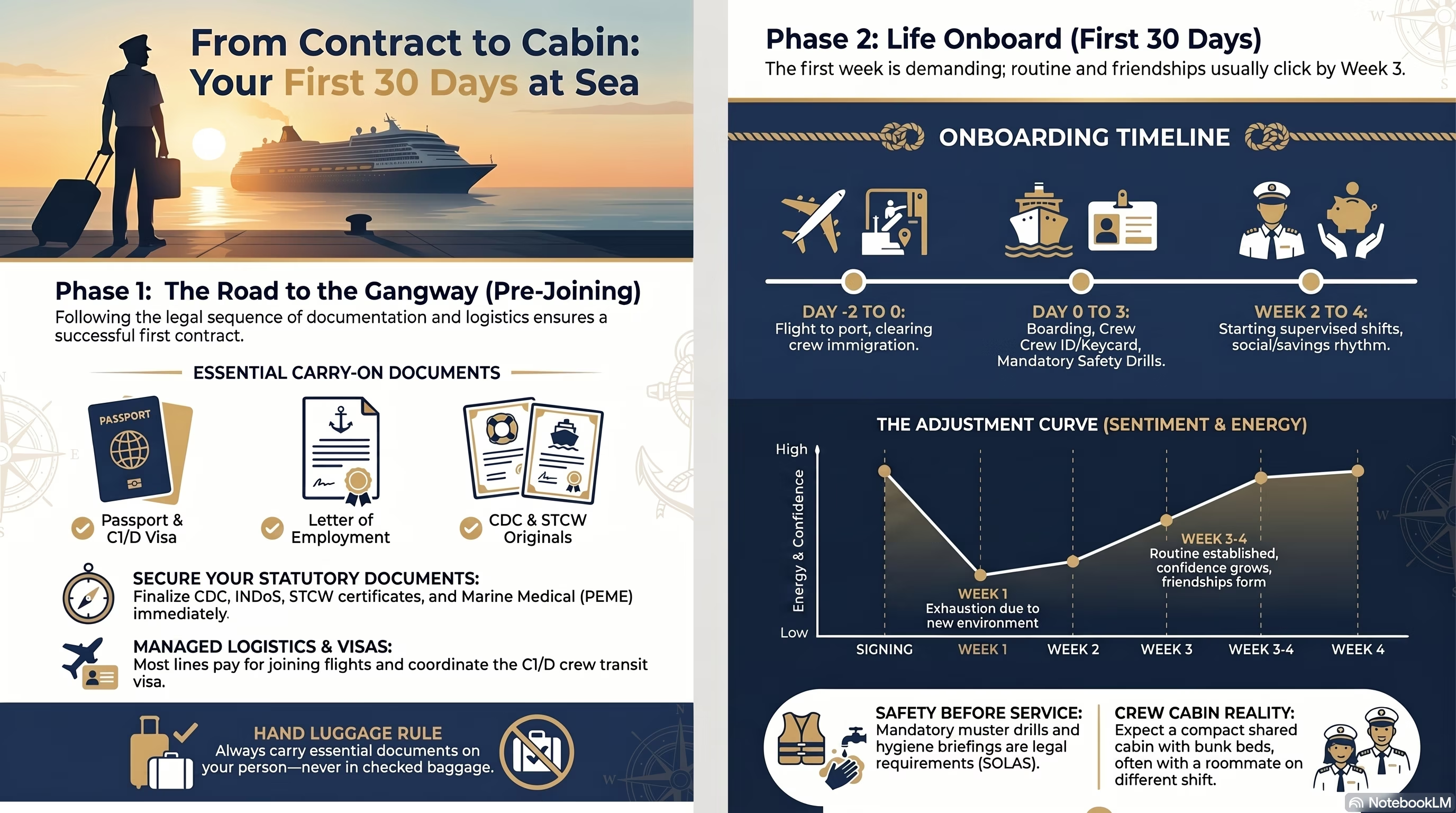
It starts with paperwork, not a plane. Once the cruise line (usually via your RPSL-licensed manning agency) confirms you, you receive a contract / letter of employment stating your position, ship, contract length, joining date and sign-on port. Read every line — your role, your contract duration (typically six to nine months for Indian hospitality crew), and any pre-joining requirements. Your agency will then guide the next steps: visa, flights and a joining date. Keep digital and printed copies of this letter; you will need it at immigration and at the gangway. This is also the moment to finalise your statutory documents if anything is pending — your CDC, INDoS number, STCW certificate and a valid marine medical (PEME) must all be in order before you fly. Wings does not issue any of these; they come from DG Shipping-approved channels, and your agency confirms they are complete.
Step 2 — Flights, visa and the journey to the sign-on port
Here is reassuring news for first-timers worried about cost and logistics: most cruise lines arrange your joining flight and very often pay for it, then coordinate your travel to the sign-on port — the city where you board the ship. You will usually need the correct visa (frequently a C1/D crew transit visa for US sign-ons, or the relevant country's seafarer/crew visa) which your agency helps you obtain — never assume you can travel on a tourist visa. Your agency briefs you on the airport, any transfer or hotel arranged before boarding, and who to contact on arrival. The single most important rule: carry ALL your documents — passport, CDC, STCW, letter of employment, visa, medical — in your hand luggage, never in checked baggage. If your bag is delayed, your documents must still be on you to sign on.
“Currently I'm pursuing my aviation course from wings institute.Teachers of wings institute are very kind to us. It's a very good place for aviation and hotel management learning. The infrastructure is superb. The placement cell is also on point.”
Contract, documents & visa
Sign the letter of employment, confirm CDC/INDoS/STCW and marine medical are valid, and obtain the crew visa your agency arranges. Lock your packing list and keep all documents in hand luggage.
Flights & sign-on port
Travel on the line-arranged (usually paid) flight to the sign-on port. You may overnight in an arranged hotel, then transfer to the ship. Clear immigration as a signing-on crew member.
Boarding, ID & keycard
Board at the gangway, hand over documents, get your crew ID / keycard, photo and cabin assignment. Security and the crew office process you in; you meet your supervisor or HR.
Safety, muster & role training
Complete the mandatory muster/emergency drill, USPH and hygiene briefings, and role-specific training. This is law (SOLAS/STCW) and comes BEFORE your real job starts.
First shifts & the steep week
Start supervised shifts, learn the ship's layout, meet your team and cabin-mate, and ride out the exhausting, slightly homesick first week that nearly every first-timer feels.
Adjusting & finding your rhythm
The routine clicks, friendships form, the ship stops feeling like a maze, and you settle into the on-contract rhythm. The hardest part is almost always behind you by now.
Step 3 — Sign-on at the port: immigration and the gangway
Arriving at the sign-on port is where it suddenly feels real. You typically clear immigration as a signing-on crew member — meaning you present your passport, crew visa and letter of employment, and the authorities process you as joining crew, not a tourist. A ship's agent or your manning agency's local contact often meets joining crew to guide them; follow their instructions and stay with your group. Then comes the gangway — the bridge from shore to ship. At the gangway, ship security checks your documents against the crew manifest, scans you in, and directs you to the crew office. First-timers often describe this moment as equal parts thrilling and terrifying: you are carrying everything you own up a ramp onto a city-sized vessel where you know no one. That feeling is completely normal. Breathe, keep your documents ready, and let the process carry you.
Step 4 — Boarding, your crew ID and keycard
Once aboard, the crew office and security take over. You hand in your documents (the ship often holds your passport securely for the contract — standard practice), get photographed, and receive your crew ID card / keycard. That card is your life onboard: it is your identity, your door key, your meal and time-clock card, and your scan-on/scan-off pass every time you leave or return to the ship. You will be told your cabin number, your department and supervisor, and where to report. Expect to be handed a small mountain of information at once — your brain will not retain all of it, and that is fine. Write down your cabin number, your muster station and your supervisor's name; those three are the ones you cannot afford to forget on day one.
"On day one I'll be thrown straight into my real job — serving guests or cleaning cabins — and judged on it immediately, so I have to be perfect from the first hour."
That is not how joining works. Before you do any 'real' job, the ship is legally required to put you through safety and emergency training — a muster/emergency drill, USPH and hygiene briefings, and role-specific orientation. SOLAS and STCW make this mandatory for every crew member, and it comes first precisely because safety outranks service. Your actual shifts usually start supervised, with senior crew showing you the ropes. Nobody expects a first-timer to be flawless on day one; they expect you to take safety seriously and learn fast. The pressure you are imagining is real, but it is spread across your first week, not crammed into your first hour.
Step 5 — Safety and muster drills: the part that's actually the law
This is the stage first-timers underestimate, and it is the most important. Within your first day or two you will complete a mandatory muster drill — the emergency assembly procedure where you learn your muster station, how to don a lifejacket, evacuation routes and your role if an alarm sounds. You will also get USPH (US Public Health) and hygiene briefings, because outbreak prevention is taken with deadly seriousness on cruise ships, and role-specific training for your department. None of this is box-ticking. SOLAS (Safety of Life at Sea) and your STCW training exist because at sea, safety is survival. Pay genuine attention — supervisors notice who treats drills seriously and who doesn't, and it shapes their first impression of you. If a briefing is fast or accented and you miss something, ask. 'Can you repeat that, please?' is always better than guessing on a safety matter.
Step 6 — Your cabin and your cabin-mate
Then you find your home for the next several months: a small crew cabin below the guest decks, almost always shared with one other crew member, with bunk beds, a compact shared bathroom and just enough storage for a packed life. Your cabin-mate may be from the Philippines, Indonesia, India or anywhere — often on a different shift, so one of you sleeps while the other works. Be honest with yourself: there is no privacy in the way you have at home. But here is the reassurance — the overwhelming majority of crew adapt within days, and many form their closest ship friendships with their cabin-mate. Basic cabin courtesy goes a long way: keep your half tidy, be quiet when they're sleeping, share the bathroom fairly, and introduce yourself warmly on day one. A good relationship with your cabin-mate makes the whole contract easier.
First-timer joining checklist: don't board without these
- Passport (valid well beyond contract end) plus the correct crew/seafarer visa your agency arranged — never travel on a tourist visa.
- Letter of employment / contract, printed and digital — needed at immigration and the gangway.
- CDC, INDoS number and original STCW certificate — carried in hand luggage, never checked baggage.
- Valid marine medical (PEME) certificate confirming you are fit to sail.
- All documents in your cabin/hand bag, photographed on your phone and emailed to yourself as backup.
- Black formal shoes, grooming kit and any uniform items your agency specified — plus modest, practical clothing for off-duty.
- A small amount of USD cash, an unlocked phone, and your supervisor's and agency's contact details written down.
- Memorised on day one: your cabin number, your muster station, and your supervisor's name.
Step 7 — Your first shifts and learning the ship
Once safety training clears, your real work begins — usually supervised at first. Whether you are an assistant waiter learning the dining-room flow, a cabin steward shadowing a senior on stateroom turnaround, or a galley assistant finding your station, expect to start by watching and following. The ship itself is a maze: crew corridors (the 'I-95' or main crew thoroughfare), service lifts, the crew mess, the time-clock points — it takes days before you stop getting lost. Your shifts will be long and the pace fast, because the onboard hotel never closes. You will make small mistakes; everyone does. What supervisors actually want in week one is not perfection — it's punctuality, a willing attitude, attention to hygiene and safety, and the humility to ask and learn. Get those right and you will be fine, even while you're still finding your feet.
Expert Insight
"Let me be completely honest, because no recruiter will say this: your first week at sea will likely be the hardest week of the whole contract. You'll be jet-lagged, overwhelmed by information, physically tired from long shifts, surrounded by strangers and accents, and quietly homesick all at once. Many first-timers privately wonder on day three whether they made a mistake. They didn't. This steep, lonely, exhausting first week is the near-universal experience of new crew — and it passes. By week two or three the routine clicks, the ship stops feeling like a maze, friendships form, and your financial WHY comes back into focus. Anchor yourself to that goal on the hard days, give yourself grace to be a beginner, and ride it out. The crew who quit in week one almost always regret it."
Adjusting: how the first contract settles
Adjustment is not a single moment; it's a curve. The first few days are pure overload. The first week is steep and tiring. But somewhere in week two or three, something shifts — you know your way around, your shifts feel less frantic, you've made a friend or two in the crew mess, and the homesickness softens from a constant ache into manageable waves. You learn the rhythm of crew life: the crew bar and parties, the gym, the crew mess meals, the WhatsApp call home when the limited, expensive internet allows. You start banking real savings because your cabin, meals and flights are covered. None of this erases the hard parts — the long days, the months away, the no-full-days-off at sea — but it reframes them as the cost of a goal you chose. For the fuller honest picture of life at sea, read our guide on whether a cruise ship career is worth it for Indians before and during your first contract.
Where Wings Institute honestly fits
Let me draw the boundary plainly, because your trust matters more than a quick admission. Wings Institute, training Vadodara students since 2008, is a hospitality career-readiness academy. We prepare you for the parts of joining that confidence and skill decide — service standards, food and beverage and housekeeping fundamentals, grooming, spoken English fluency and interview readiness — so you arrive at the gangway prepared, not panicked. Here is what we do NOT do, stated so no one can mislead you: we do not issue STCW certificates or your CDC/INDoS, we have no RPSL manning-agency tie-up, and we do not arrange your sign-on, flights, visa or boarding. Those run through DG Shipping-approved channels, your licensed manning agency and the cruise line itself. Anyone promising to 'place you onboard' or 'guarantee your joining' for a fee is misleading you. We make you ready; the official channels handle the joining.
So that is the honest cruise ship joining process, end to end: a signed contract and letter of employment, then line-arranged flights and the right crew visa, sign-on at the port and the walk up the gangway, boarding with your ID and keycard, the mandatory muster and safety drills that come before everything else, your shared cabin and cabin-mate, your first supervised shifts, and the gradual, real adjustment that turns a terrifying first week into a settled contract. The fear you feel before you fly is normal — almost every first-timer feels it. But the process is far more orderly than the anxiety in your head, and the steep first week is something hundreds of thousands of crew have ridden out before you. Prepare your documents, prepare your mindset, anchor yourself to your goal, and walk up that gangway knowing exactly what comes next.
“Love the learning process and also faculties are also very helpful 👍”

Shilpa Rathod
Verified Google ReviewFrequently Asked Questions
What is the cruise ship joining process for an Indian first-timer?
Who books and pays for cruise ship joining flights from India?
What happens on the first day when you join a cruise ship?
What is a muster drill and is it compulsory on a cruise ship?
Do you share a cabin on a cruise ship and who is your cabin-mate?
Is the first week on a cruise ship really that hard?
Does Wings Institute arrange cruise ship joining, flights or STCW?
“Joining Wings Institute was the best decision I ever made! The environment is so positive and encouraging. The faculty gives individual attention to every student and helps polish our personality, grooming, and interview skills. Truly the best aviation and cabin crew institute in Gujarat.”
Explore Cruise Line Training
Don't just read about it. Experience it. Use our AI tools to assess your current standing for free.
Action Now