
01
Phonics & sound discipline
Indian-language sound-mapping to English phonemes. Practice on the consonants and vowels that most often trip Gujarati and Hindi speakers — soft / hard pairs, word-final endings, syllable stress.
Loading...
Around 70% of Wings cabin crew students start from Gujarati or Hindi medium with weak spoken English. The English bridge — phonics to ICAO Level 4+ aviation English — is built into every batch. Empathetic faculty, judgement-free start, recruiter-grade finish.
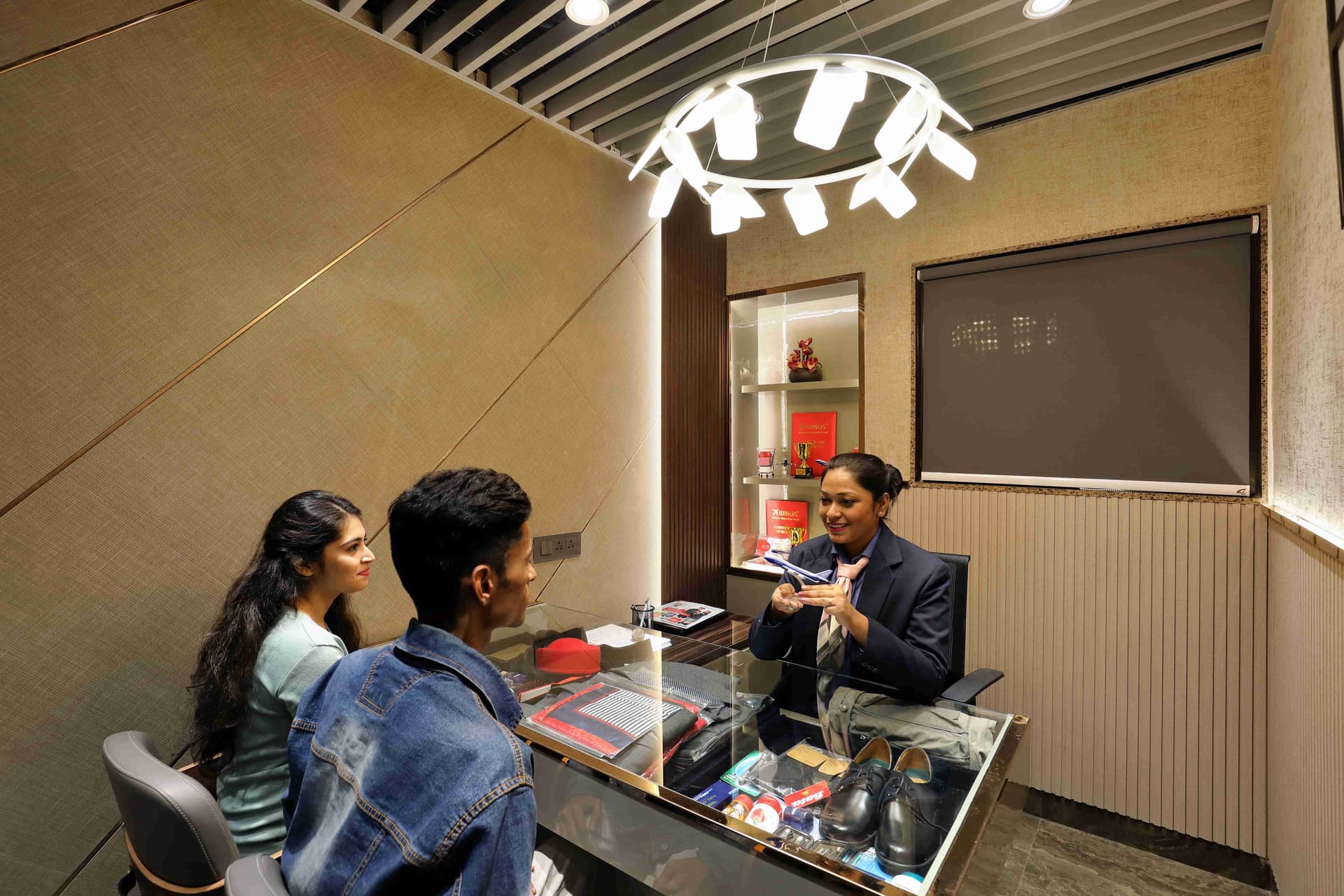
From silent in interviews to confident on the PA — coached one rep at a time.
Spoken-English bridge for cabin-crew aspirants. Pronunciation, role-play, mock HR rounds. Built for students who start at zero.
Most institutes treat weak English as a disqualifier. Wings treats it as a starting point. Around seven out of ten cabin crew students join from Gujarati or Hindi medium — the syllabus is designed around that reality, not against it.
Foundation weeks include bilingual instructor support — explanations in Gujarati or Hindi when needed. Practical drills (PA, role-play, interview answers) are run in English from day one so the muscle builds. By month 4–6 most students hit interview-grade fluency. By placement week the language flows.
No accent erasure. Wings does not teach fake accents. The goal is clarity — to be understood by every passenger, every recruiter. Your identity stays. Recruiters hire clear communicators, not impersonators.
You have studied in Gujarati or Hindi medium and rarely spoken English aloud. We start with phonics and sentence patterns. By batch end you handle a full English boarding sequence.
You can read and write English but freeze when speaking. We unlock fluency with role-play, shadowing and PA scripts. The grammar already in your head gets activated.
Your English is fine but you go quiet in front of strangers. We rebuild speaking confidence with low-pressure pair work first, then group, then mock interview, then recruiter day.
You speak English but feel self-conscious about your accent. We work on clarity (so you are understood) without erasing your identity. Recruiters do not hire fake accents — they hire clear communicators.
Roughly seven out of ten Wings cabin crew students join from a Gujarati or Hindi medium background. The English bridge is built into every batch — not a paid add-on.
The aviation English module is built around the ICAO English Language Proficiency standard so the level you reach matches what airlines test in the recruiter interview.
During the foundation weeks, instructors explain in Gujarati or Hindi as needed. The transition to English-only delivery happens gradually as your confidence grows.
Aviation English is practised inside the wide-body mock cabin — PA scripts on the announcement-grade system, role-plays at real seat pitch, in-flight pickup tempo.
Record yourself reading PA scripts and interview answers. Listen back, correct, re-record. The most under-used technique in fluency-building, run as a daily habit at Wings.
The full English bridge is included in the Air Hostess & Cabin Crew Training fee — and an online English-for-cabin-crew course is also available standalone for working professionals.
Structured English bridge built into the Air Hostess & Cabin Crew Training program. Grouped by area — foundation, aviation English, listening, speaking, interview, writing, practice.
Indian-language sound-mapping to English phonemes. Practice on the consonants and vowels that most often trip Gujarati and Hindi speakers — soft / hard pairs, word-final endings, syllable stress.
Grammar through patterns, not through rules — ten high-frequency sentence patterns (subject + verb + object, question forms, present continuous, past simple, modal verbs) drilled to automatic recall.
Standard cabin crew phrases — greetings, safety briefings, beverage and meal service, special-meal handling, complaint acknowledgement, end-of-flight thanks. Built around real airline scripts.
Pronunciation, fluency, comprehension, vocabulary, structure and interaction practised against the ICAO English Language Proficiency standard. Recorded self-listening for self-correction.
Listening drills across Indian, British, American, Gulf and Filipino English accents. Speed graded — slow → normal → fast — so passenger-call comprehension holds across the global passenger mix.
Soften the strongest interference patterns (vowel substitution, "v/w", "th") for clarity, while keeping your natural identity. The goal is to be understood — not to fake an accent.
Welcome aboard, taxi, take-off, turbulence, cruise, descent, landing and deplaning announcements — practised in English first, then bilingual transitions. Voice projection, pace and clarity drilled to PA-grade.
Polite refusals, soft escalations, apology framing, allergen and dietary acknowledgements, kneel-side child interactions and culturally-aware international guest English.
"Tell me about yourself", "Why cabin crew", "How would you handle an angry passenger", group discussion contributions, situational responses. Answers practised, not memorised — natural delivery rehearsed.
Live role-plays in the Wings A330 mock cabin — boarding, beverage service, meal service, complaint handling, post-flight thanks. Recorded, reviewed and re-run until the language flows.
A 30-minute daily routine students keep through batch, internship and the first year on roster — listening, shadowing, journaling, vocabulary review and one role-play with a partner.
Cabin crew email templates (sick-leave, leave-application, transfer requests), WhatsApp message tone for crew rooms and recruiter follow-ups. Spelling, punctuation and tone discipline.
Full 1-year cabin crew program. English bridge is built in.
30-day online head-start course before joining the main program.
Trilingual FAQ for families. Safety, faculty, real numbers.
Book a free counselling visit. Walk through the bridge in person.
Yes. Around 70% of Wings cabin crew students join from a Gujarati or Hindi medium background and start with weak spoken English. The English bridge is built into every batch — phonics, sentence patterns, ICAO Level 4+ aviation English, PA announcement practice, interview answers, role-play in the A330 mock cabin. By placement interview week, students handle the full English service flow with confidence.
No prior English speaking confidence is required. Reading and writing at 12th-pass level is enough. The foundation weeks include bilingual instructor support; English-only delivery is built up gradually as your confidence grows.
Aviation English and the spoken-English bridge are part of the Wings Air Hostess & Cabin Crew Training program at /air-hostess-training. A focused 30-day online course — English for Cabin Crew — is also available at /online-courses/aviation-english-communication/learn for working professionals or aspirants who want a head-start.
Most students reach interview-grade English within 4–6 months of consistent practice during the program. The remaining months refine PA delivery, role-play tempo and recruiter-day answers. Daily 30-minute practice continues through internship and the first year on roster.
No. Wings does not teach accent erasure or fake accents. The goal is clarity — you should be understood by every passenger. We soften the interference patterns that block clarity (vowel substitution, "v/w", "th") and keep your natural identity. Recruiters hire clear communicators, not fake accents.
ICAO English Language Proficiency is the international standard the aviation industry references for English ability. Level 4 ("operational") is the working minimum for global cabin and cockpit crew on international routes. Wings aviation English is built around the ICAO standard so the level you reach matches what recruiter interviews test.
Yes. The foundation weeks include bilingual instructor support — explanations in Gujarati or Hindi as needed. Practical drills (PA, role-play, interview practice) are run in English so you build the muscle. Bilingual support tapers off as your confidence grows.
You start small. Pair work with one batch-mate, then small group, then full group, then mock interview, then recruiter day. The Wings classroom is judgement-free during the early weeks and most students surprise themselves by month 3. The faculty have seen the same starting point hundreds of times.
No. The English bridge is included in the Air Hostess & Cabin Crew Training fee — not a paid add-on. The standalone online English for Cabin Crew course is separate and is for aspirants who want a 30-day head-start before joining the main program.
Absolutely. Free campus visits Monday to Saturday, 10 AM to 7 PM. Parents are encouraged to walk through the classroom, watch a live English session and meet the faculty. Trilingual FAQ for families is also at /parents.
Free counselling Monday to Saturday, 10 AM to 7 PM. Speak in Gujarati, Hindi or English — whichever feels right. Bring your parents if you like.