
01
Passenger acceptance & check-in
Read the PNR, verify ID, allocate seat (window/aisle, exit row eligibility, regulatory seat blocks), capture frequent-flyer details, generate the boarding pass and meet airline-specific check-in cut-off rules.
Loading...
Master Departure Control System workflows — Amadeus Altéa, NAVITAIRE, SITA, CUTE/CUSS — at Wings Institute Vadodara. Check-in, baggage, boarding, IROPS, weight & balance. Part of the Airport Management program.
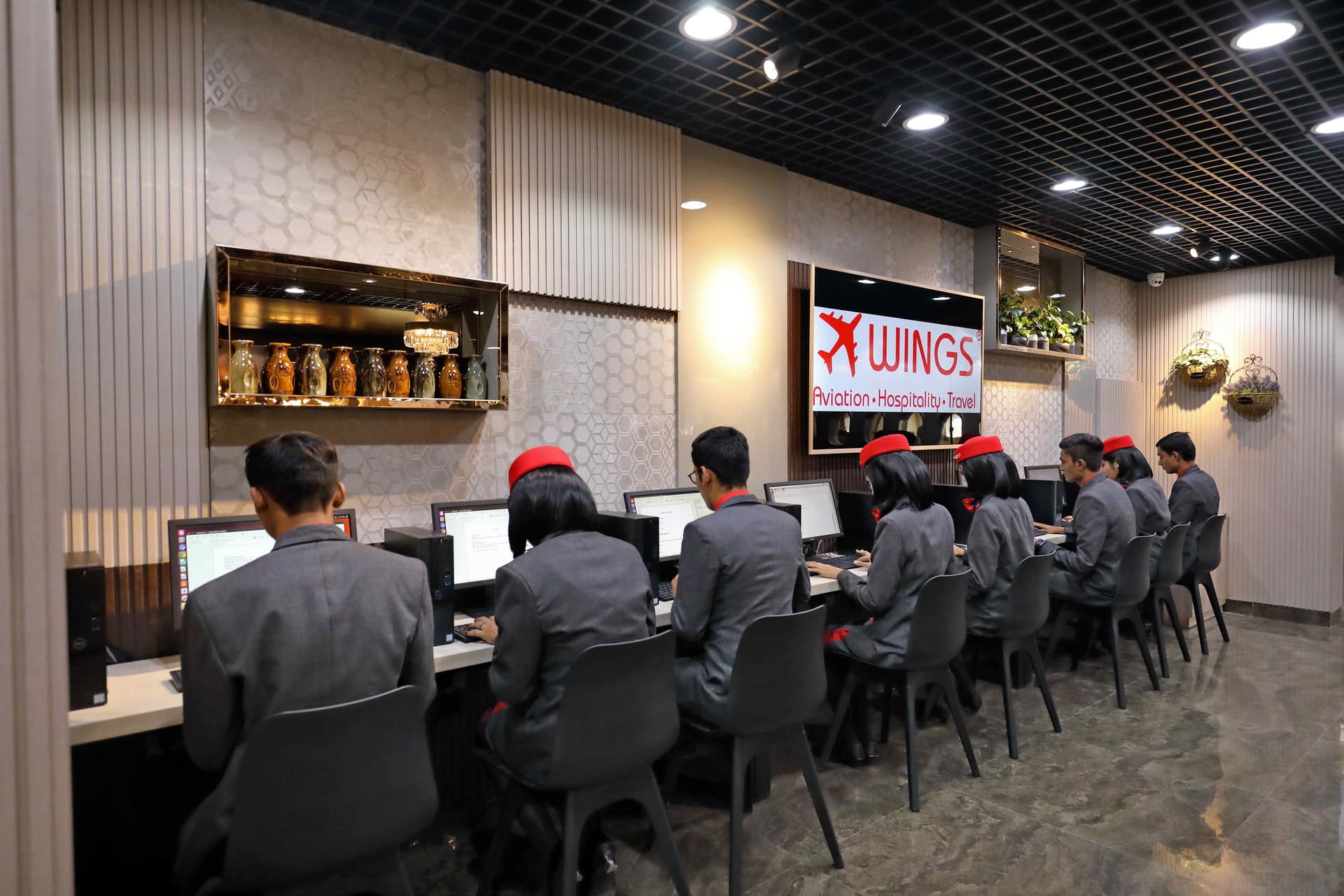
Real Departure Control terminals. Real Amadeus & Sabre workflows.
Check-in, boarding, baggage tags, PNR handling — practised on industry DCS in our airport-ground-staff computer lab.
Every airport check-in counter, boarding gate and ramp office runs on a Departure Control System. Whether you join IndiGo, Air India, AI-SATS, Celebi, Bird Group or Adani Airport, the first 60 days of your job are spent inside a DCS — opening flights, accepting passengers, tagging bags, boarding the aircraft, closing out.
Wings DCS-focused training teaches workflows that map across Amadeus Altéa, NAVITAIRE New Skies, SITA Horizon and the CUTE / CUSS shared workstations every Indian airport uses. By the time you sit a recruiter assessment you already know the language of the gate.
Most widely deployed DCS across full-service carriers worldwide; covers customer management, flight management and self-service.
Common DCS used by several Indian and international carriers across CUTE airport workstations.
Primary DCS for low-cost carriers — IndiGo and similar — combines reservation + DCS in one ecosystem.
Common-Use airport terminals (CUTE) and self-service kiosks (CUSS) used by ground staff to operate any airline's DCS from a shared bay.
Wings DCS training uses simulated workflows that map to the families above; it is institute-led training, not an airline-issued DCS certification. Airline-specific DCS certificates are issued only after you join an airline / ground handler and complete their internal program.
Structured DCS workflows practised by every Airport Management cohort. Grouped by station task — check-in, baggage, boarding, operations, systems.
Read the PNR, verify ID, allocate seat (window/aisle, exit row eligibility, regulatory seat blocks), capture frequent-flyer details, generate the boarding pass and meet airline-specific check-in cut-off rules.
Create and read SSR codes — UMNR, WCHR, MEDA, BLND, INFT, AVIH, PETC, DEPA / DEPU. Coordinate with airline ground services and lounge teams for fulfilment.
Verify passport validity, visa class, OCI / PIO documents, transit visa requirements, API submission to destination authorities and Timatic / TIM Sub Manual lookup discipline.
Apply piece-concept and weight-concept allowances, identify hazardous and restricted items, generate IATA baggage tags, route bags via interline / online connection rules and handle excess baggage payment workflow.
Open and close the gate per the boarding sequence, scan boarding passes, manage standby and upgrade lists, handle no-shows, gate-no-shows and last-minute add-ons. Reconcile the headcount before doors close.
Match scanned boarding passes to seat-by-seat boarding count, reconcile baggage tags against the BRS, identify and offload bags of no-show passengers per security rules.
Read the loadsheet, understand zero fuel weight, take-off weight, MAC % and CG envelope. Coordinate with the load controller and apprise the cockpit of any last-minute change.
Manage delays, diversions, cancellations, mis-connections and offload procedures. Process passenger reaccommodation, hotel-acco vouchers, meal vouchers and EU261 / DGCA awareness for impacted travellers.
Read interline electronic ticketing (IET), MITA / SITA agreements, recheck-baggage rules, code-share segments and ensure boarding pass and baggage tags route correctly through hub airports.
Close the flight in the DCS post-doors-closed, send LDM / MVT messages, file the passenger manifest, handle left-behind bags, complete the station handover log and prepare for the next flight.
Understand PNL, ADL, BSM, LDM, MVT and other Type B / EDI messages exchanged between the DCS, central reservation system, baggage system and station partners.
Operate Common-Use Terminal Equipment shared by multiple airlines, switch between airline DCS profiles, troubleshoot session lock-outs and use Common-Use Self-Service kiosks for passenger self check-in.
DCS stands for Departure Control System — the airline software ground staff use to check in passengers, allocate seats, accept baggage, board flights, manage irregular operations and close out a flight. Major DCS platforms include Amadeus Altéa, SITA Horizon and NAVITAIRE New Skies. Wings DCS training covers all the workflows passenger service agents and check-in agents perform in real airports.
Recruiters at IndiGo, Air India, Akasa, AI-SATS, Celebi, Bird Group and Adani Airport specifically test candidates on DCS familiarity. Even if statutory exams are short, DCS muscle memory is what gets you hired and keeps you efficient on Day 1. Standalone DCS focus inside the Wings Airport Management program means you walk into your first interview already speaking the language.
Wings DCS training is institute-led and uses simulated DCS workflows and reference data; it is not an airline-issued DCS certification. Airline-specific DCS certifications are issued only after you join an airline / ground handler and complete their internal training. Wings training prepares you to clear the recruiter assessment + complete airline DCS onboarding faster.
DCS workflows are part of the Wings Institute Airport Management & Ground Staff Training program at /airport-management. Standalone DCS focus content is also covered as part of the Online Airport Ground Handling Operations micro-course at /online-courses/airport-ground-handling.
CRS (Central Reservation System — e.g. Amadeus, Sabre) holds the booking. GDS (Global Distribution System) lets travel agents and corporates access multiple CRS systems to ticket. DCS (Departure Control System) is what the airport ground team uses to check in, board and close the flight. Wings curriculum covers GDS in the Travel & Tourism program and DCS in the Airport Management program.
Most ground handling and airline check-in roles require 12th pass + good English + DCS familiarity + on-job grooming. A degree is not mandatory for the entry roles. Career growth into supervisor / station-controller positions is faster with a degree but not blocked without one.
As an indicative range, ground staff freshers in India typically earn ₹18,000 – ₹35,000 per month depending on airline / ground handler, station, shift load and English proficiency. International ground roles (Gulf, Singapore) start higher with allowances. Wings does not promise a fixed salary — final CTC is decided by the recruiter.
Wings trains workflows that map to all three families — Amadeus Altéa (full-service carriers), NAVITAIRE New Skies (LCC carriers like IndiGo) and SITA Horizon (multi-carrier airports) — plus CUTE / CUSS workstation behaviour. Specific airline DCS certification is added once you join the airline.
Yes. Wings Airport Management students learn CUTE workstation discipline — switching airline DCS profiles, handling session lock-outs, troubleshooting login issues and using CUSS kiosks for passenger self check-in. CUTE familiarity is asked about in most ground staff interviews at major Indian airports.
New Airport Management batches start every month at the Wings Vadodara campus, with major intakes in January, April, July and October. Free counselling visits are encouraged Monday to Saturday, 10 AM to 7 PM — see /admissions or call +91 875 875 4444 to confirm the next batch.
Free counselling visits Monday to Saturday, 10 AM to 7 PM at the Wings Vadodara campus. See the GDS / DCS lab and meet faculty before deciding.