

Cruise English Test (Marlin / CES) Prep for India: Practice & How to Pass 2026

"Most Indian freshers don't lose a cruise job at the interview — they lose it at the English test. The Marlin Test (and the CES Marine English assessment) is the quiet gate between you and your contract. Here's exactly what it checks, why so many capable candidates fail it, and a clear-eyed prep plan to walk in ready."
If you're working toward a cabin or galley job on an international cruise line, you'll meet a checkpoint that catches more Indian freshers off guard than the interview itself: the English test. On most lines this is the Marlin Test — a standardised maritime English assessment — and some lines or agencies use a CES (Crew Evaluation System) Marine English module instead. Whatever the label, the purpose is the same: can you understand instructions, give clear information, and handle a safety or service situation in English, fast and without confusion? This guide breaks down what the test checks, gives you sample-style practice items, and lays out a realistic prep plan from Vadodara. For the full picture of the role itself, see our pillar guide on the International Cruise Line Training Program.
What the cruise English test actually checks
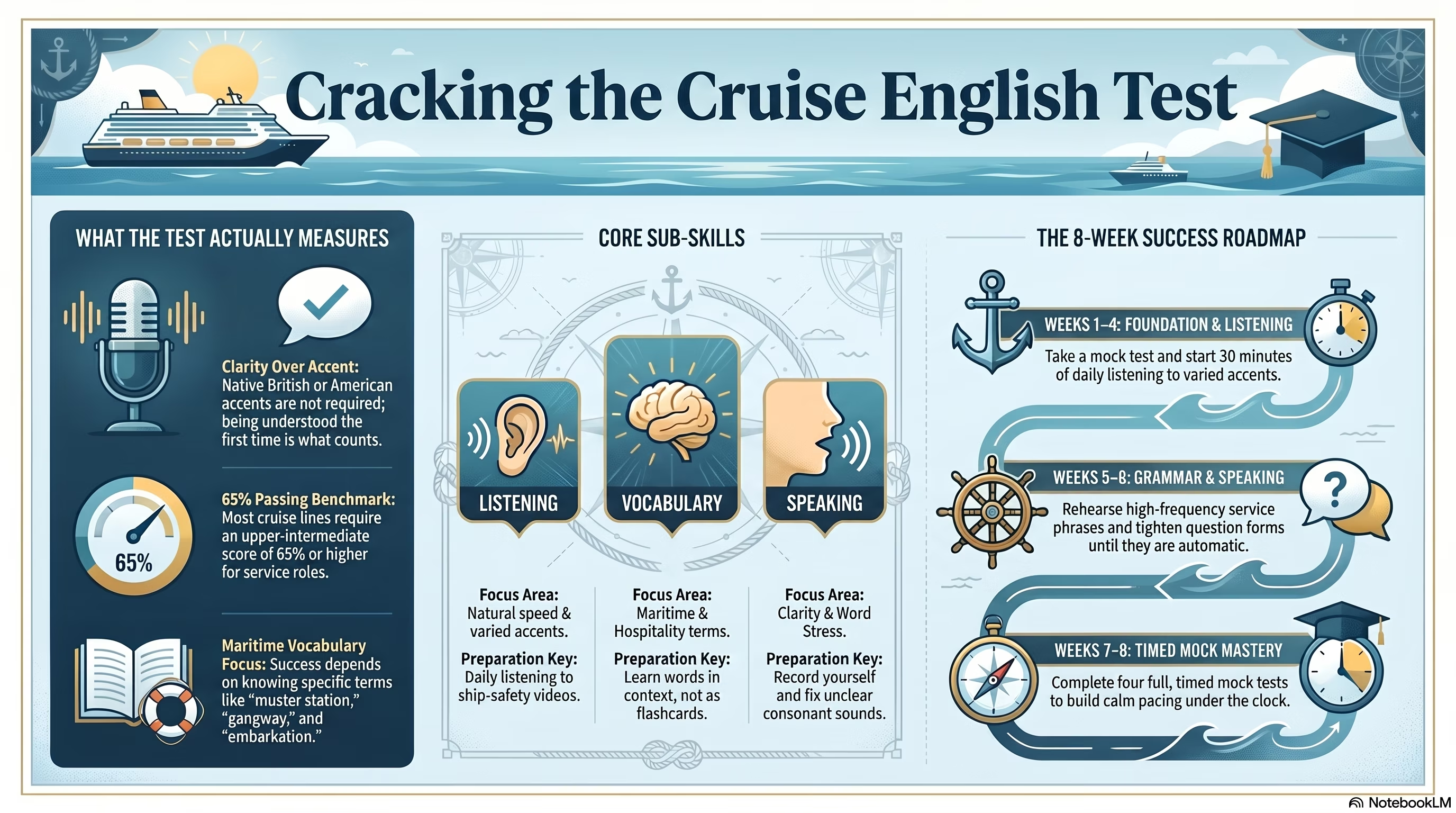
The Marlin Test and CES Marine English assessments are built around the working reality of a ship: an international crew, English as the common operational language, and zero room for misunderstanding during a drill or an emergency. So the test isn't an academic English exam. It samples the specific sub-skills you'll use on board.
| Test section | What it checks | How to prepare |
|---|---|---|
| Listening comprehension | Understanding spoken English at natural speed — announcements, instructions, crew dialogue, often in different accents | Daily listening to varied accents (news, ship-safety videos, native speakers); train yourself to grasp meaning at full speed, not word-by-word |
| Vocabulary & maritime terms | Knowing service, safety, and shipboard vocabulary (muster, embarkation, galley, gangway, abandon-ship, allergen) | Build a maritime + hospitality word list; learn terms in context, not as flashcards; practise using them in sentences |
| Grammar & sentence structure | Forming correct, clear sentences under time pressure | Drill common tenses and question forms; focus on the structures used to instruct, apologise, and inform guests |
| Reading comprehension | Understanding written safety notices, menus, signage, and short passages | Read shipboard-style notices and summarise them aloud; practise scanning for the key instruction quickly |
| Speaking / pronunciation (where assessed) | Being clearly understood — clarity and correct stress, NOT a native accent | Record yourself, fix unclear sounds, slow down slightly; rehearse high-frequency service phrases until they're automatic |
“I has been a wonderful.experiwnce..i happened to.learn lot many things 🙂”
What level of English do you actually need?
Cruise lines and manning agencies generally look for an upper-intermediate working level of English — enough to handle guests and safety duties independently. For the Marlin Test you'll often hear a benchmark around 65% or higher for guest-facing and service roles, with some positions set higher. But here's the honest part: the exact pass mark and the chosen test are decided by the specific cruise line or recruitment agency you apply through — not by any institute. Always confirm the current requirement for your role and line before you assume a number.
"You need a 'perfect' British or American accent to pass the cruise English test and work on ships."
No. The Marlin and CES assessments reward clarity, not a particular accent. What's measured is whether you understand instructions correctly and whether a listener understands you the first time, using the right maritime and service vocabulary. A clear, neutral Indian-English accent that's easy to follow passes; a 'fancy' accent that's mumbled or grammatically off does not. Spend your energy on clarity, correct words, and confident pace — not on imitating an accent.
Why so many Indian freshers fail here (and it's not what they think)
After years of preparing candidates in Vadodara, the failure pattern is remarkably consistent — and very fixable once you see it.
- 1Listening speed, not knowledge: candidates understand English on paper but can't keep up when audio plays at natural pace with an unfamiliar accent. They translate in their head and fall behind.
- 2Missing maritime vocabulary: everyday English is fine, but words like 'muster station', 'embarkation', 'gangway', 'allergen', or 'abandon ship' aren't second nature — so a whole question becomes a guess.
- 3Freezing under the clock: the test is timed, and nerves turn good English into hesitant, broken English.
- 4Pronunciation that isn't clear: not 'wrong accent', but unclear consonants or wrong word stress that make a correct answer hard to understand.
- 5Treating it as a one-day task: many freshers try to 'mug up' the night before. Listening fluency and vocabulary recall simply don't build overnight — they build over weeks.
A practical prep plan: 8 weeks to test-ready
You don't need a year. A focused 8-week routine, done consistently, moves most upper-beginner candidates to a confident pass-level. Here's the timeline we use as a backbone.
Diagnose & build the base
Take an honest mock to find weak spots. Start 30 min/day of listening to varied accents and learn the first 50 maritime/service terms in context.
Vocabulary + listening speed
Add the next 50–80 terms. Do timed listening drills; train to grasp meaning at full speed without mentally translating.
Grammar & speaking clarity
Tighten tenses and question forms. Record service phrases daily, fix unclear sounds and word stress, rehearse until automatic.
Full mock tests under time
Simulate the test end-to-end, timed, twice a week. Review every error, retest weak sections, and build calm pacing under the clock.
Your cruise English test readiness checklist
- I can follow spoken English at natural speed in at least 2–3 different accents without freezing.
- I know and can use core maritime + safety vocabulary (muster, embarkation, gangway, allergen, abandon ship) in a sentence.
- I can give a clear instruction or apology to a guest in correct, complete English.
- I have completed at least 4 full, timed mock tests and reviewed every mistake.
- My pronunciation is clear enough that a stranger understands me the first time.
- I have confirmed the actual test (Marlin or CES) and the pass mark with my specific cruise line or agency.
Sample practice items (try these aloud)
These mirror the style of what you'll face. Don't just read them — say the answers out loud and time yourself.
- 1Listening-style: You hear, 'All crew, proceed to your muster stations for the scheduled drill.' Where must you go, and what is happening? (Answer fully in one clear sentence.)
- 2Vocabulary: A guest reports an 'allergen' concern at dinner. What does this mean, and what is your first response as service crew?
- 3Service phrasing: Rewrite 'No, finished, not possible' into a polite, clear guest-service sentence.
- 4Reading: A notice says, 'Embarkation begins at 1300; gangway closes 30 minutes prior to departure.' By what time must guests be on board, relative to departure?
- 5Grammar/clarity: Turn 'Yesterday I am working at restaurant' into correct, clear English.
"No problem sir, I doing it fast fast, you wait small."
"Of course, sir — I'll take care of that right away. It will take just a few minutes."
How Wings prepares you — and what it honestly cannot do
At Wings Institute in Alkapuri, Vadodara, our spoken-English training is Cambridge-certified, and we drill exactly the sub-skills the Marlin and CES tests measure: listening at natural speed across accents, maritime and hospitality vocabulary in context, clear pronunciation, and confident pacing under time pressure. We run mock assessments so the real test feels familiar, not frightening. To be completely clear on compliance: the Marlin Test and any CES Marine English assessment are administered through the cruise line or its recruitment agency — not through Wings. We prepare you to walk in ready; we do not conduct the official test, set the pass mark, or guarantee a result. That separation is exactly how it should be.
Expert Insight
"The English test is one gate, not the whole journey. Sequence it with the rest of your application: read our step-by-step guide on how to get a cruise ship job in India after 12th, and once your English is solid, prepare for the panel with our cruise ship interview questions for India 2026. Strong English makes the interview easier — they reinforce each other."
Here's the encouraging truth: the cruise English test is one of the most controllable parts of your entire application. Unlike hiring waves or contract timing, your Marlin or CES readiness is built entirely by your own consistent practice. Treat it like training for a sport — daily reps, honest mocks, and clarity over accent — and you turn the gate that stops most freshers into the one you walk through with confidence.
“Awesome place to give wings to your dreams, and opportunity to do different from the rest world!”

Namrata Bhamblani
Verified Google ReviewFrequently Asked Questions
What is the Marlin Test for cruise ship jobs?
What is the difference between the Marlin Test and the CES English test?
What level of English do I need to pass the cruise English test?
Do I need a perfect English accent to pass?
Why do so many Indian freshers fail the cruise English test?
How long does it take to prepare for the Marlin or CES test?
Does Wings Institute conduct the Marlin or CES test?
Can I prepare for the cruise English test from Vadodara?
“Joining Wings Institute was the best decision I ever made! The environment is so positive and encouraging. The faculty gives individual attention to every student and helps polish our personality, grooming, and interview skills. Truly the best aviation and cabin crew institute in Gujarat.”
Explore Cruise Line Training
Don't just read about it. Experience it. Use our AI tools to assess your current standing for free.
Action Now