

Cruise Ship Interview Questions India 2026: 15 Q&A + USPH / Bin System

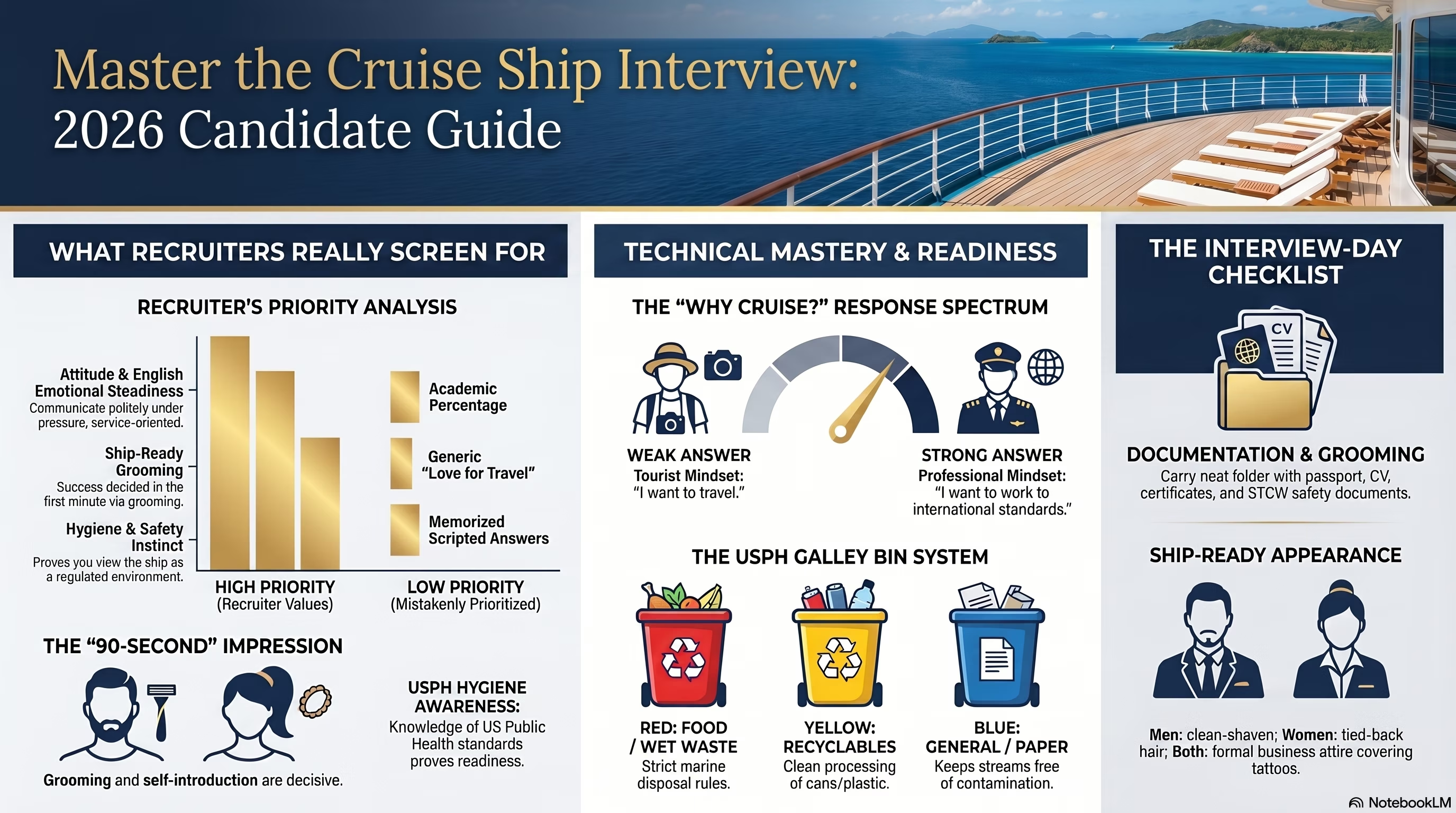
"The cruise interview is where most Indian freshers either win their first contract or lose it in the first ninety seconds. After years of prepping Wings students for hiring-partner panels, here are the 15 questions you will most likely face in 2026 — with model answers, what recruiters actually listen for, and the USPH 'bin colour' hygiene question that catches almost everyone off guard."
For an Indian fresher, the cruise ship interview is the single highest-stakes hour in the whole journey from classroom to gangway. You have done the diploma, your documents are in order, your STCW basic safety training is sorted — and then everything comes down to how you speak, stand and respond in front of a hiring-partner panel that interviews thousands of candidates a year. The good news: cruise interviews are remarkably predictable. The same families of questions come up again and again, because recruiters are testing the same handful of things — clarity of English, guest-service instinct, hygiene awareness, and whether you will survive 6–8 months in a tiny shared cabin without becoming a problem. This guide walks through the 15 questions you are most likely to face in 2026, with model answers and, crucially, the reasoning behind each one. If you are still earlier in the journey, read our step-by-step hub on how to get a cruise ship job in India after 12th and the full overview on our international cruise line training program pillar page first, then come back here to prepare for the panel itself.
A quick, honest framing before the questions: there are no magic words that guarantee a 'yes'. A recruiter is forming an overall impression — can they imagine you smiling at a demanding guest at 11pm after a 12-hour day. Your job in the interview is not to sound rehearsed; it is to sound calm, warm and ready.
What cruise recruiters are really screening for
Before the questions, understand the filter. Cruise hiring partners in India interview huge volumes of freshers for hospitality, galley, housekeeping, bar and guest-services roles. They are not hunting for the highest academic scorer. They are screening for: spoken English a guest from anywhere in the world can understand; a genuine service attitude under pressure; basic hygiene and safety awareness (because a ship is a USPH-regulated environment); emotional steadiness for long contracts away from home; and grooming that already looks 'ship-ready'. Read every model answer below as evidence you are offering for one of those boxes.
“It's very nice And good to get knowledge from wings”
The 15 most likely cruise interview questions (with model answers)
These are grouped the way a real panel tends to flow — introduction, motivation, service scenarios, then hygiene/safety and contract-readiness. Adapt the wording to your own life; never memorise these word-for-word, because recruiters can hear a scripted answer instantly.
15 questions and model answers
- 11. 'Tell me about yourself.' — Keep it to 45–60 seconds, structured: name and city, your hospitality/cruise diploma, one real example of guest or customer service, and why a cruise career suits you. Example: 'I'm Priya from Vadodara. I completed my cruise and hospitality diploma at Wings Institute, where I trained in food and beverage service and guest handling. During a hotel internship I learned to stay calm with difficult guests, and I'm now ready for the discipline and guest focus of life at sea.'
- 22. 'Why do you want to work on a cruise ship?' — Avoid 'I love travelling.' Anchor it in service and growth: 'A cruise ship is one of the most intense guest-service environments in the world. I want to build a strong hospitality career, work with guests and crew from many countries, and grow within a structured, international company.'
- 33. 'Why should we select you over the other candidates?' — Be specific and humble: 'I'm trained for this exact environment, my English is clear, I follow grooming and hygiene standards strictly, and I'm reliable — I understand a contract is a commitment I will honour fully.'
- 44. 'What do you know about working on a cruise ship?' — Show realistic awareness: long contracts of around 6–9 months, shared cabins, long shifts, USPH hygiene standards, and guest service as the core of every role. Recruiters love candidates who already know it is hard work, not a holiday.
- 55. 'A guest is angry and shouting at you. What do you do?' — Use a simple calm structure: 'I would stay calm, listen fully without interrupting, apologise sincerely for their experience, and solve it or escalate to my supervisor. I never argue with a guest.'
- 66. 'A guest asks for something you cannot provide. How do you respond?' — 'I never say a flat no. I explain what I can do instead and offer the nearest alternative, so the guest still feels looked after.'
- 77. 'How do you handle working long hours, far from family, in a shared cabin?' — Be honest and mature: 'I've thought about this seriously. I'll stay connected with family when I can, keep a routine for rest and fitness, and focus on my goals. I know it's demanding, and I'm prepared for it.'
- 88. 'Are you comfortable working with people from different countries and cultures?' — 'Yes — that's one of the things I'm most excited about. I'll respect every culture, keep an open mind, and use clear, polite English so communication is never a barrier.'
- 99. 'What are your strengths and weaknesses?' — Pick a real, job-relevant strength (calm under pressure, fast learner) and a genuine but improvable weakness with how you're working on it. Avoid clichés like 'I'm a perfectionist.'
- 1010. 'What is good hygiene on a cruise ship?' — This is a screening question. Mention frequent handwashing, glove use, keeping work areas sanitised, never reporting sick to a food area, and the USPH-inspected standards a ship must meet.
- 1111. 'What do the different coloured bins in the galley mean?' — The red–yellow–blue waste-segregation question. A confident answer here sets you apart instantly (full explanation in the bin-system section below).
- 1212. 'Can you work in a team?' — Give a concrete example: 'During training and my internship I worked in service teams where one person falling behind affects everyone. I support my colleagues and ask for help when needed — on a ship the whole department depends on teamwork.'
- 1313. 'Are you willing to do any job assigned to you on board?' — The honest answer is yes: 'I understand entry-level cruise roles can involve any task in my department, including cleaning and setup. I'm ready to start at the bottom and prove myself.'
- 1414. 'What is your salary expectation?' — Don't quote a wild figure. 'I'm aware salary depends on role, position and tips, and the company's standard package is acceptable to me. Right now my priority is getting the experience and building my career.'
- 1515. 'Do you have any questions for us?' — Always have one ready: ask about the role, the training given on board, or the typical career path. Never make your first question about salary or days off — ask about the work.
Expert Insight
"If your 'tell me about yourself' answer is rambling or memorised, the panel has already half-decided before you reach question two. Rehearse it out loud until it is calm and natural — not perfect, just confident. This is exactly what we drill repeatedly in Wings interview prep, because it is the single highest-leverage 60 seconds a fresher will ever practise."
"I really love travelling and I want to see the world and visit different countries. Cruise ship is my dream because I can travel for free and earn money at the same time."
"A cruise ship is one of the most demanding guest-service environments anywhere, and that's exactly where I want to build my hospitality career. I want to work to international standards, serve guests from many cultures, and grow within a structured company. The travel is a bonus — the real attraction is the level of service and discipline I'll learn."
The USPH hygiene question — why it comes up and how to nail it
Almost every Indian fresher is surprised by how much weight cruise interviews put on hygiene. The reason is the USPH — the United States Public Health programme, run through the CDC's Vessel Sanitation Program, which inspects cruise ships calling at US ports. A poor inspection score is a serious commercial problem for a cruise line, so every crew member — not just the galley team — is expected to understand and live by these standards. When a recruiter asks a hygiene question, they are testing whether you treat a ship as the tightly-regulated, public-health-inspected environment it actually is, rather than just 'a hotel that floats'.
What strong USPH-awareness answers include
- 1Frequent, thorough handwashing — and knowing that hand sanitiser supplements but does not replace soap-and-water washing.
- 2Never working in or near food areas if you are unwell, especially with any stomach symptoms — you report sick instead.
- 3Keeping work surfaces, equipment and high-touch areas sanitised on a schedule.
- 4Correct use of gloves and following food temperature and storage rules in galley/F&B roles.
- 5Understanding that the ship is subject to USPH/VSP inspections, so standards are non-negotiable, all day, every day.
"Hygiene rules on a cruise ship are basically the same as a normal hotel, so I don't need to prepare for that question."
Cruise ships operate under USPH/Vessel Sanitation Program inspection standards that are stricter and more systematically enforced than a typical hotel. Outbreak prevention is a constant priority in a closed environment with thousands of people, so handwashing protocols, sick-reporting and waste segregation are taken extremely seriously — and recruiters genuinely screen for whether you understand this.
The red–yellow–blue bin question, explained
The galley waste-segregation question is the one that quietly separates a prepared candidate from an unprepared one. Cruise galleys use a colour-coded bin system so that different waste streams are separated correctly — this matters for hygiene, for environmental compliance (ships have strict garbage-management rules at sea), and for safe handling. Exact colour schemes can vary slightly between cruise lines, so in your answer it is smart to say 'the system I've trained on uses…' and then explain the principle. The principle — separating food waste, recyclables/dry waste and general or hazardous waste — is what recruiters actually want to hear you understand.
| Bin colour | Typical waste stream | Why it's separated |
|---|---|---|
| Red | Food / wet waste (and in some schemes, hazardous/sharps) | Food waste is processed/disposed under strict marine rules; must never mix with recyclables |
| Yellow | Recyclables / dry waste such as cans, plastics, glass (line-dependent) | Recyclable streams are kept clean and separate for proper processing |
| Blue | General / paper / other dry waste (line-dependent) | Keeps the general stream free of food contamination and recyclables |
Expert Insight
"Because colour schemes differ between cruise lines, don't risk reciting the wrong colours as absolute fact. Lead with the principle — 'waste is segregated by stream for hygiene and environmental compliance' — then give the colour example you trained on. That shows understanding, not rote memory, and protects you if their scheme differs slightly."
Interview-day checklist: documents, grooming, what to wear
Many strong candidates lose offers on avoidable basics — a missing document, over-casual clothing, or grooming that isn't 'ship-ready'. Treat the checklist below as non-negotiable. You want zero distractions between you and a confident performance on the questions above.
Before you walk into the cruise interview
- Documents: passport (valid, with adequate validity), CV/resume copies, passport-size photographs, diploma/certificates, STCW and any medical documents — carry originals plus copies in a neat folder.
- Grooming (women): clean, tied-back hair, light professional make-up, minimal jewellery, neat manicured nails, no strong perfume.
- Grooming (men): clean-shaven or neatly trimmed and groomed, short tidy hair, no visible stubble, trimmed nails.
- What to wear: formal business attire — for men a well-fitted formal shirt, trousers and polished shoes (tie/blazer is a safe choice); for women a formal shirt with trousers or a knee-length skirt, or a smart formal dress, with closed formal shoes.
- Cover visible tattoos and remove excessive piercings — many cruise lines have visible-tattoo and grooming policies.
- Arrive early, phone on silent, and bring a calm, warm smile — first impression starts before the first question.
- Rehearse your 60-second introduction and your one good question to ask the panel.
How Wings prepares you for the cruise panel — honestly
At Wings Institute in Alkapuri, Vadodara, interview preparation is built into our cruise and hospitality training, not bolted on at the end. We run mock interviews on these exact question families, drill the self-introduction, coach grooming and body language to cruise-line standards, and make sure students genuinely understand USPH hygiene and galley waste segregation so the hygiene questions become easy marks rather than surprises. We are direct with every student about the boundary, though: Wings is a training academy that prepares you and connects you with hiring partners — we do not, and cannot, guarantee selection. The final decision always belongs to the cruise line and its recruiters. What we can do is make sure that when your turn in front of the panel comes, you are as ready, calm and professional as anyone in the room.
Prepare these 15 questions, internalise the USPH and bin-system logic, nail your grooming and documents, and you walk in having removed every avoidable reason for a 'no'. Practise your answers out loud, and treat the interview as a conversation you've already had a dozen times in your head. For the bigger picture of the whole journey — eligibility, costs, timeline and roles — return to our international cruise line training program pillar and the how to get a cruise ship job in India after 12th hub.
“Celebrate all fastival in wigs institute”

Solanki Kinjal
Verified Google ReviewFrequently Asked Questions
What are the most common cruise ship interview questions in India?
What is the USPH question in a cruise interview?
What do the red, yellow and blue bins mean on a cruise ship?
How should I prepare for a cruise ship interview as a fresher?
What should I wear to a cruise ship interview?
How do I answer 'why do you want to work on a cruise ship'?
Does Wings Institute guarantee a cruise ship job after the interview training?
Is the cruise interview difficult for someone with average English?
“Joining Wings Institute was the best decision I ever made! The environment is so positive and encouraging. The faculty gives individual attention to every student and helps polish our personality, grooming, and interview skills. Truly the best aviation and cabin crew institute in Gujarat.”
Explore Cruise Line Career Training
Don't just read about it. Experience it. Use our AI tools to assess your current standing for free.
Action Now