

6 Soft Skills Every Hospitality Professional Needs: Complete Hospitality Soft Skills & Communication Training Guide 2026
"You can have the best hotel management degree, but without the right hospitality soft skills, your career will stall. I have seen it countless times—technically qualified candidates rejected in interviews because they lacked communication training and interpersonal abilities. Hotels and airlines do not just hire qualifications; they hire personalities. The good news? Unlike technical knowledge, skills can be developed with conscious effort and proper training. This guide covers the 6 essential hospitality soft skills that separate successful professionals from the rest."
Why Hospitality Soft Skills Matter More Than Degrees
Before we dive into specific skills, understand why hospitality soft skills are career-critical:
The Hiring Reality:
🏨 Technical skills get you the interview; soft skills get you the job 🏨 90% of guest complaints relate to staff attitude, not service quality 🏨 Promotions in hospitality are based on people management, not just performance 🏨 The highest-paid hospitality roles (GM, Director) require exceptional interpersonal abilities
Industry Research:
A study by Cornell University's School of Hotel Administration found that managers rated hospitality soft skills as 3x more important than technical competencies when evaluating candidates.
The Gujarat Context:
In our experience placing students across Gujarat's hotels and airports, candidates with strong communication training backgrounds consistently outperform those with better academic scores but weaker interpersonal abilities.
Our Hotel Management and Air Hostess Training programmes integrate soft skills development throughout the curriculum.
Skill #1: Communication Training – The Foundation of Hospitality
Communication training is the most critical of all hospitality soft skills. Every interaction in hospitality—with guests, colleagues, and supervisors—depends on clear, professional communication.
Why Communication is Non-Negotiable:
💬 You interact with 50-200 people daily in hospitality roles 💬 Miscommunication causes service failures and guest complaints 💬 Career growth requires presenting ideas and leading teams 💬 International hospitality demands multilingual abilities
The Three Types of Communication in Hospitality:
1. Verbal Communication: - Clear pronunciation and appropriate volume - Professional vocabulary (avoid slang) - Positive language ("Certainly" instead of "Okay") - Active listening and confirmation
2. Written Communication: - Professional email etiquette - Clear documentation and reports - Error-free spelling and grammar - Appropriate tone for different audiences
3. Non-Verbal Communication: - Confident body language - Appropriate eye contact - Professional facial expressions - Respectful physical distance
How to Develop Communication Skills:
📝 Daily Practice: - Read English newspapers aloud for 15 minutes - Record yourself speaking and identify areas for improvement - Practice in front of a mirror for body language awareness
📝 Formal Training: - Join communication training programmes - Participate in group discussions and debates - Take public speaking courses
📝 Real-World Application: - Volunteer for customer-facing roles - Practice with friends and family - Seek feedback actively
Communication Training at Wings Institute:
Our communication training module includes: - Daily English speaking practice - Accent neutralisation exercises - Role-play scenarios - Guest interaction simulations - Professional email writing
Skill #2: Emotional Intelligence – Reading People & Situations
Emotional Intelligence (EQ) is among the most valued hospitality soft skills—the ability to understand and manage emotions, both yours and others'.
Why EQ Matters in Hospitality:
🧠 Guests arrive with different moods and expectations 🧠 You must stay calm when guests are angry 🧠 Team dynamics require understanding colleagues' perspectives 🧠 Leadership roles demand empathy and people management
The Four Components of EQ:
1. Self-Awareness: - Recognising your own emotions - Understanding your triggers - Knowing your strengths and weaknesses
2. Self-Management: - Controlling impulsive reactions - Staying calm under pressure - Adapting to changing situations
3. Social Awareness: - Reading others' emotions accurately - Understanding unspoken needs - Recognising cultural differences
4. Relationship Management: - Building positive relationships - Resolving conflicts diplomatically - Inspiring and influencing others
Real-World EQ Example:
A guest arrives at the front desk, clearly frustrated after a delayed flight. A low-EQ staff member might take the frustration personally and respond defensively. A high-EQ professional:
✅ Recognises the guest is tired and stressed (not personally upset) ✅ Offers empathy: "I understand how exhausting travel delays can be" ✅ Provides immediate comfort: "Let me expedite your check-in" ✅ Goes extra: "Would you like me to arrange room service for dinner?"
This turns a potentially negative experience into a loyalty-building moment.
How to Build EQ:
- Practice mindfulness and self-reflection - Ask for feedback on your interpersonal style - Observe high-EQ professionals and learn - Read books on emotional intelligence - Engage in diverse social situations
“Give best platform for achieving our dreams thank you”
Skill #3: Problem-Solving – Turning Complaints into Opportunities
Problem-solving is a critical hospitality soft skill—the ability to resolve issues quickly, creatively, and satisfactorily.
The Problem-Solving Reality:
🔧 Problems occur daily in hospitality (overbookings, complaints, equipment failures) 🔧 How you solve problems defines guest experience 🔧 Creative problem-solving creates memorable moments 🔧 Management roles require strategic problem-solving
The LEARN Framework for Problem-Solving:
L – Listen fully to understand the problem E – Empathise with the guest's feelings A – Apologise sincerely (even if not your fault) R – React with a solution or alternatives N – Notify relevant departments and follow up
Common Hospitality Problems & Solutions:
| Problem | Poor Response | Skilled Response | Result |
|---|---|---|---|
| Room not ready at check-in | "Please wait" | Offer lounge access, refreshments, expedite cleaning, upgrade if possible | Guest feels valued |
| Food allergy concern | "I'll ask the chef" | Personally verify ingredients, offer alternatives, ensure safe preparation | Guest trusts you |
| Flight delay (cabin crew) | "Not our fault" | Provide updates, offer water, assist with connections, show genuine concern | Passengers stay calm |
| Double booking | "System error" | Apologise, offer immediate alternative, complimentary upgrade, follow-up | Potential negative becomes positive review |
| Loud room neighbours | "I'll tell them" | Offer room change, apologise sincerely, provide small compensation | Guest appreciates proactivity |
How to Develop Problem-Solving Skills: 🔧 Study case studies of hospitality service recovery 🔧 Practice the LEARN framework in daily life 🔧 Role-play problem scenarios with colleagues 🔧 Learn from experienced professionals 🔧 Develop a solutions-first mindset The Empowerment Factor: Top hotels empower staff to solve problems on the spot. Ritz-Carlton famously allows every employee to spend up to $2,000 per guest to resolve issues without manager approval. This skill of quick, empowered problem-solving creates legendary service.
Skill #4: Teamwork & Collaboration – No Solo Stars in Hospitality
Hospitality is inherently team-based. Strong teamwork is among the essential hospitality soft skills because service delivery depends on multiple departments working in harmony.
Why Teamwork is Critical:
👥 A single guest experience involves multiple teams (front desk, housekeeping, F&B, concierge) 👥 Shift handovers require seamless communication 👥 Busy periods demand collective effort 👥 Career growth requires ability to lead teams
The Hospitality Service Chain:
Consider a simple room service order:
1. Front Desk takes the order 2. Kitchen prepares the food 3. Stewarding provides equipment 4. Room Service delivers 5. Housekeeping clears later
If any link breaks, the guest experience suffers. Strong teamwork skills ensure the chain holds.
Elements of Effective Teamwork:
✅ Clear Communication: Share information proactively ✅ Mutual Respect: Value every team member's contribution ✅ Flexibility: Help colleagues when needed, even outside your role ✅ Reliability: Deliver on commitments to the team ✅ Conflict Resolution: Address issues constructively ✅ Collective Success: Celebrate team wins, not personal achievements
Teamwork Across Departments:
At Wings Institute, we simulate multi-department scenarios where students from different programmes work together—just like in real hotels and airports. This builds collaboration skills before you enter the industry.
How to Demonstrate Teamwork:
- Volunteer for group projects - Support colleagues during their busy periods - Share credit for successes - Communicate handover information thoroughly - Build relationships across departments
Skill #5: Adaptability & Flexibility – Thriving in Constant Change
Adaptability is a crucial hospitality soft skill—the ability to adjust quickly to changing situations, schedules, and demands.
Why Adaptability is Essential:
🔄 Hospitality schedules change constantly 🔄 Guest needs are unpredictable 🔄 Technology and systems evolve rapidly 🔄 Industry trends shift continuously 🔄 Crisis situations require immediate pivots
Types of Adaptability in Hospitality:
1. Schedule Flexibility: - Rotational shifts (morning, evening, night) - Weekend and holiday work - Overtime during busy periods - Last-minute roster changes
2. Task Flexibility: - Multi-tasking across roles - Helping other departments when needed - Learning new skills quickly - Handling unexpected requests
3. Situational Flexibility: - Adjusting to different guest personalities - Managing crisis situations calmly - Adapting to new policies and procedures - Responding to industry changes
Real Adaptability Example:
During COVID-19, hospitality professionals had to: - Learn new safety protocols overnight - Adapt to contactless service - Handle anxious guests with extra care - Work with reduced teams - Shift to new roles as demand changed
Those with strong adaptability skills not only survived but often advanced, while rigid professionals struggled.
How to Build Adaptability:
🔄 Embrace change as opportunity, not threat 🔄 Learn continuously—new skills, technologies, trends 🔄 Practice outside your comfort zone regularly 🔄 Maintain positive attitude during transitions 🔄 Build diverse experiences across departments
Skill #6: Cultural Sensitivity – Serving a Diverse World
Cultural sensitivity is an increasingly important hospitality soft skill—the ability to understand, respect, and adapt to guests from different cultural backgrounds.
Why Cultural Sensitivity Matters:
🌍 Hospitality serves guests from 100+ countries 🌍 Cultural norms vary significantly (greetings, eye contact, space) 🌍 Dietary and religious requirements differ 🌍 Communication styles vary across cultures 🌍 Mistakes can cause serious offence
Cultural Sensitivity in Practice:
| Culture/Region | Important Consideration | How to Adapt |
|---|---|---|
| Middle East | Gender interaction norms, halal food, prayer times | Offer same-gender service if preferred, ensure halal options, qibla direction |
| Japan | Formal greetings, attention to detail, indirect communication | Bow slightly, meticulous service, read between the lines |
| USA | Friendly informality, directness, prompt service | Warm greeting, first-name basis okay, quick responses |
| India | Vegetarian requirements, family hierarchy, personal space | Verify dietary needs, respect elders, moderate physical distance |
| China | Business card etiquette, tea culture, number significance | Receive cards with both hands, offer tea, avoid number 4 |
Building Cultural Sensitivity: 🌍 Learn basics of major cultures you will encounter 🌍 Never assume—ask politely when unsure 🌍 Observe and adapt to guest preferences 🌍 Respect differences without judgement 🌍 Stay updated on global events affecting travellers Gujarat's Cultural Advantage: Students from Gujarat often have inherent cultural sensitivity—exposure to diverse communities (Hindu, Muslim, Jain, Christian, Parsi) within the state. This background is valuable in hospitality. At Wings Institute in Vadodara, we build on this foundation with formal cultural awareness training.
How Wings Institute Develops Hospitality Soft Skills
At Wings Institute, hospitality soft skills development is integrated into every programme—not treated as an afterthought.
Our Approach:
📚 Communication Training Module: - Daily English speaking practice - Group discussions and presentations - Accent neutralisation - Professional email writing - Guest interaction role-plays
📚 Practical Skill Building: - Real-world simulations in mock facilities - Industry visits to observe professionals - Guest lectures by hospitality leaders - Peer feedback sessions - Recorded practice with review
📚 Personality Development: - Grooming and personal presentation - Body language training - Confidence building exercises - Interview preparation - Leadership development
📚 Industry Exposure: - Internship placements - Airport and hotel visits - Interaction with working professionals - Real guest handling practice
Our Location:
📍 Address: 2nd floor, RG Square 14, Nutan Bharat Society, Alkapuri, Vadodara - 390007 📞 Phone: +91-8758754444 🕐 Hours: Monday to Saturday, 10:00 AM - 7:00 PM 📍 Directions: Open in Google Maps
Explore our Hotel Management, Air Hostess Training, Airport Management, and Culinary Arts programmes—all with integrated skills development.
Conclusion: Skills That Build Careers
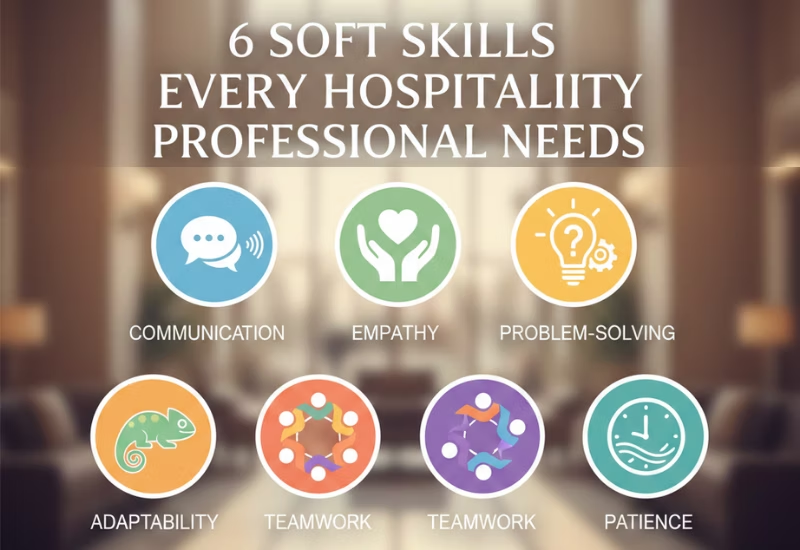
Let me summarise the 6 essential hospitality soft skills every professional needs:
The Essential 6:
1️⃣ Communication – Clear, professional, multilingual 2️⃣ Emotional Intelligence – Understanding and managing emotions 3️⃣ Problem-Solving – Turning issues into opportunities 4️⃣ Teamwork – Collaborating across departments 5️⃣ Adaptability – Thriving in constant change 6️⃣ Cultural Sensitivity – Serving a diverse world
Key Takeaways:
✅ Soft skills are career differentiators—technical knowledge is expected; soft skills set you apart ✅ Communication training is foundational—invest heavily in this area ✅ Skills can be developed—with conscious effort and proper training ✅ Practice makes permanent—daily application matters more than theory ✅ Professional training accelerates development—structured programmes provide focused skills building
The Bottom Line:
In hospitality, your personality is your product. Guests remember how you made them feel more than what you did. Hospitality soft skills create those memorable feelings.
Ready to start your career?
Visit Wings Institute in Alkapuri, Vadodara for a free counselling session. We will assess your current skills, identify development areas, and create a personalised training plan.
📞 Call: +91-8758754444 📍 Address: 2nd floor, RG Square 14, Nutan Bharat Society, Alkapuri, Vadodara - 390007 🕐 Hours: Monday to Saturday, 10:00 AM - 7:00 PM 📍 Directions: Open in Google Maps
Your skills development journey starts with the right training. Let Wings Institute be your guide.
“The institute is nice and the ability to learn is also nice it make us to be open in public”

Wahida Makrani
Verified Google ReviewFrequently Asked Questions
What are hospitality soft skills?
Why is communication training important in hospitality?
Can soft skills be learned or are they natural?
How do hotels assess soft skills in interviews?
Which hospitality soft skill is most important?
How long does it take to develop hospitality soft skills?
Does Wings Institute provide communication training?
How do soft skills affect hospitality salary?
What is emotional intelligence in hospitality?
How can I improve my hospitality soft skills at home?
“Joining Wings Institute was the best decision I ever made! The environment is so positive and encouraging. The faculty gives individual attention to every student and helps polish our personality, grooming, and interview skills. Truly the best aviation and cabin crew institute in Gujarat.”
Develop Your Hospitality Skills
Don't just read about it. Experience it. Use our AI tools to assess your current standing for free.
Action Now