

Chef vs. Cook: Why Culinary School Matters | Complete Culinary Arts Course & Professional Chef Training Guide 2026

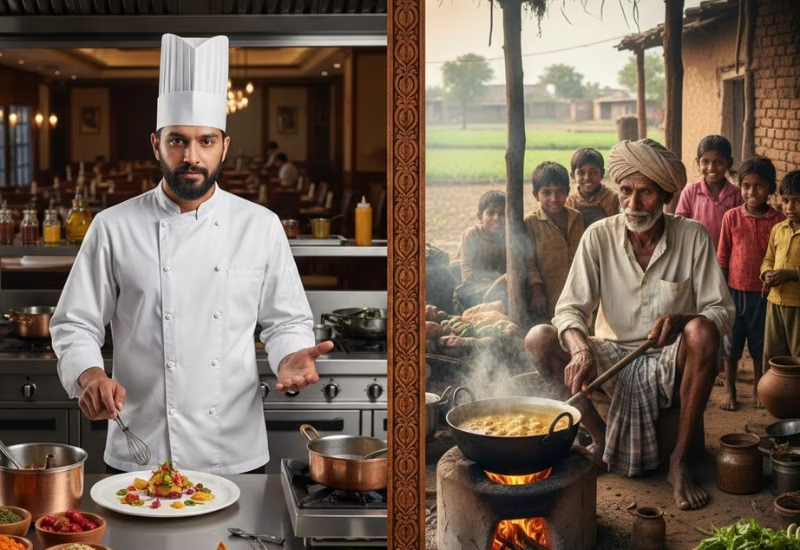
"Your family runs a restaurant. You have been cooking since you were 15. People say your food is delicious. So why would you need a culinary arts course? This is the chef vs. cook debate. Many talented home cooks believe they can skip formal training and jump into the hospitality industry. Some succeed—but most struggle to advance beyond basic kitchen roles. Professional chef training provides something home cooking cannot: systematic technique, food safety certifications, kitchen management skills, and career credentials. I have seen this pattern repeatedly at Wings Institute, Vadodara. Students who invest in proper professional chef training advance faster, earn more, and build sustainable culinary careers. Today, I am explaining exactly why culinary school matters—and when it might not."
Chef vs. Cook: Understanding the Fundamental Difference
Let us start with definitions. In the culinary world, these titles mean different things:
What is a Cook?
A cook is someone who prepares food. This includes: - Home cooks who prepare family meals - Line cooks who work stations in restaurants - Short-order cooks in cafes and diners - Helpers who assist in commercial kitchens
Cooks can be excellent at what they do. Many have learned through years of experience. However, 'cook' is a role, not a career title with formal recognition.
What is a Chef?
Chef (from French 'chef de cuisine') literally means 'head of the kitchen.' A chef: - Has formal culinary training or equivalent professional experience - Understands cuisine theory, not just recipes - Manages kitchen operations, staff, and inventory - Creates menus and develops new dishes - Holds responsibility for food quality, safety, and cost control
Chef is a career designation that comes with professional recognition, higher salaries, and leadership responsibilities.
The Key Distinction:
| Aspect | Cook | Chef | |--------|------|------| | Training | Often self-taught or on-job | Formal culinary education | | Scope | Follows recipes | Creates and develops recipes | | Responsibility | Station or task | Entire kitchen operation | | Career Path | Limited progression | Clear hierarchy (CDP, Sous, Executive) |
A culinary arts course bridges this gap—transforming talented cooks into professional chefs.
Explore our Culinary Arts Training to understand what formal training provides.
What Professional Chef Training Actually Teaches
If you already know how to cook, what does a culinary arts course add?
Beyond Cooking: The Full Curriculum
Core Components of Professional Chef Training
- 1Classical Techniques: Mother sauces, knife skills, cooking methods (braising, poaching, sautéing), stock preparation, baking fundamentals. These form the foundation of all cuisines.
- 2Food Science: Why does meat brown? What makes bread rise? Understanding the science behind cooking makes you a better, more adaptable chef.
- 3Cuisine Theory: French, Italian, Asian, Indian regional cuisines. Understanding flavour profiles, ingredient pairings, and cultural contexts.
- 4Menu Engineering: Designing menus for profitability, balancing food costs, seasonal planning, portion control, pricing strategies.
- 5Food Safety & HACCP: Hazard Analysis Critical Control Points. Legal requirements for commercial kitchens. This certification is mandatory for many employer positions.
- 6Kitchen Management: Inventory control, vendor relations, staff scheduling, cost accounting, waste reduction, quality systems.
- 7Presentation & Plating: Visual appeal, garnishing, plate composition, colour theory. The difference between home cooking and restaurant presentation.
- 8Bakery & Patisserie: Breads, pastries, desserts, chocolate work. Many culinary courses include basic pastry training.
- 9Nutrition Basics: Understanding dietary requirements, allergens, healthy cooking modifications, special diets.
- 10Professional Standards: Kitchen hierarchy, uniform standards, hygiene protocols, teamwork, communication under pressure.
“very good institute for training”
Expert Insight
"Career Reality: A talented home cook might make excellent biryani. But can they make 200 portions consistently, maintain food cost at 30%, train junior cooks, handle health inspections, and develop new menu items? This is what professional chef training teaches."
Culinary Arts Course: Career Paths and Salary Comparison
Let us look at the career trajectory difference between trained and untrained professionals:
| Career Stage | Without Culinary Training | With Culinary Arts Course |
|---|---|---|
| Entry Position | Kitchen Helper, Commis III | Commis II/III, Trainee Chef |
| Starting Salary | ₹12,000-18,000/month | ₹18,000-25,000/month |
| 2-3 Years | Commis II (if lucky) | Commis I, Chef de Partie (station chef) |
| 5 Years | Commis I, possibly CDP | Sous Chef, Head of Section |
| 10 Years | Senior Cook, maybe CDP | Sous Chef, Executive Sous Chef |
| 15+ Years | Kitchen Supervisor | Executive Chef, Culinary Director |
| Maximum Salary Potential | ₹40,000-60,000/month | ₹80,000-3,00,000+/month |
| International Opportunities | Very limited | Cruise ships, Middle East, Europe |
| Entrepreneurship | Small eatery, limited scope | Restaurant ownership, consulting, food business |
The 10-Year Difference: Imagine two people starting in kitchens at age 20: Person A (No Training): Starts as helper at ₹12,000. Works hard, learns on job. By 30, reaches Commis I or CDP at ₹35,000. Struggles to advance further without formal credentials. Limited to local establishments. Person B (Culinary Course): Invests 1 year in training, starts at ₹20,000 as Commis II. By 30, is Sous Chef at ₹60,000 with 5-star experience. Has options for international career, cruise ships, hotel chains. Can consider restaurant ownership. The math: Person B invested ₹1-2 Lakhs in training but earns ₹20,000-30,000 more per month by year 5. Over 10 years, that is ₹24-36 Lakhs additional earnings—far exceeding the training investment. This is why we emphasise career outcomes over course features at Wings Institute.
Professional Chef Training: Kitchen Hierarchy Explained
Understanding the brigade system helps you see where formal training takes your career:
The French Brigade System (Used Worldwide):
| Position | English Title | Responsibilities | Training Required? |
|---|---|---|---|
| Chef de Cuisine | Executive Chef | Overall kitchen leadership, menu creation, P&L | Essential |
| Sous Chef | Under Chef | Second-in-command, operations, staff management | Essential |
| Chef de Partie (CDP) | Station Chef | Manages specific station (grill, sauce, pastry) | Highly recommended |
| Demi Chef | Half Chef | Assists CDP, can run station independently | Recommended |
| Commis I | First Cook | Experienced cook, works with minimal supervision | Recommended |
| Commis II | Second Cook | Learning cook, works under supervision | Entry point for trained |
| Commis III | Third Cook | Basic preparation, learning fundamentals | Entry point for untrained |
| Kitchen Helper | Helper | Cleaning, washing, basic prep | No training needed |
Key Insight: Without formal training, your career often stalls at Commis I or CDP level. The jump to Sous Chef and Executive Chef almost always requires culinary education or exceptional demonstrated expertise over many years. Our Culinary Arts Programme is designed to place you at Commis II level with clear progression to CDP within 2-3 years.
When Culinary Arts Course Matters Most
Formal training is especially valuable in these career scenarios:
1. Hotel and Hospitality Industry 5-star hotels (Taj, Marriott, Hyatt) strongly prefer or require formal culinary education. HR teams filter applications by qualifications. Without a certificate, your resume may never reach the kitchen chef.
2. International Careers Cruise ships, Middle East hotels, European restaurants require recognised qualifications. They cannot verify 'experience' but can verify certificates.
3. Cruise Lines Royal Caribbean, MSC, Costa, Celebrity—all require formal culinary training. These are high-paying jobs (₹80,000-1,50,000+) with travel benefits.
4. Fine Dining Establishments with complex menus, tasting courses, and high guest expectations need chefs who understand technique theory, not just recipes.
5. Entrepreneurship Opening your own restaurant? Training teaches you menu costing, food safety compliance, kitchen setup, and vendor management—not just cooking.
6. Career Changers Moving from another field to culinary? Training provides systematic knowledge faster than learning on the job while supporting your family.
7. Teaching and Consulting Want to teach cooking or consult for restaurants? Credentials matter. A culinary arts course gives you professional legitimacy.
When Might You Skip Formal Training?
In the interest of honesty, here are scenarios where formal training might be less critical:
1. Family Business Continuation If you are taking over a successful family restaurant with established systems and mentorship, on-job training may suffice—initially. However, consider training later to scale or modernise.
2. Street Food / Small Eatery Only If your career goal is a local chai stall or small dhaba with no expansion plans, investment in formal training may not provide proportional returns.
3. Already Senior with Extensive Experience If you have 15+ years of progressive kitchen experience, executive roles, and proven results, training may be redundant. (Though many senior chefs still pursue certifications.)
4. Budget Constraints with Immediate Opportunity If you have a guaranteed job offer and cannot afford training, starting work makes sense. But consider part-time or future training for career growth.
Our Position: Even in these scenarios, training accelerates growth. But we believe in honest guidance—not everyone needs to enroll immediately.
Professional Chef Training at Wings Institute, Vadodara
What makes our culinary arts course effective for building careers?
Training Infrastructure:
👨🍳 Commercial Kitchen Setup - Professional-grade equipment (ranges, ovens, grills) - Cold kitchen stations for salads, appetisers - Bakery section with industrial mixers, ovens - Plating and presentation area
👨🍳 Practical-First Approach - 70% practical, 30% theory - Real cooking, not just demonstrations - Industry-standard portions and timing - Exposure to multiple cuisines
Curriculum Highlights:
📚 Culinary Fundamentals - Knife skills, cuts, and techniques - Stocks, sauces, and soups - Cooking methods and applications - Indian regional cuisines - International cuisine basics
📚 Professional Skills - Food safety and hygiene (FSSAI awareness) - Kitchen organisation and workflow - Cost control and portion management - Menu reading and recipe scaling
📚 Career Preparation - Industry internship/exposure - Interview preparation - Resume building - Grooming and professional standards
Explore our complete hospitality offerings: Hotel Management, Airport Management, and Travel & Tourism.
Salary Expectations: Trained Chefs in India 2026
Here is what you can realistically expect with professional chef training:
| Position | Entry (0-2 yrs) | Mid (3-5 yrs) | Senior (5-10 yrs) | Expert (10+ yrs) |
|---|---|---|---|---|
| Commis Chef | ₹15,000-22,000 | ₹20,000-28,000 | N/A | N/A |
| Chef de Partie | ₹25,000-35,000 | ₹30,000-45,000 | ₹40,000-55,000 | N/A |
| Sous Chef | N/A | ₹40,000-55,000 | ₹55,000-75,000 | ₹70,000-90,000 |
| Executive Chef (Standalone) | N/A | N/A | ₹60,000-90,000 | ₹80,000-1,50,000 |
| Executive Chef (5-Star Hotel) | N/A | N/A | ₹1,00,000-2,00,000 | ₹1,50,000-3,00,000+ |
| Cruise Ship Chef | ₹70,000-1,00,000 | ₹1,00,000-1,50,000 | ₹1,50,000-2,50,000 | ₹2,00,000-4,00,000 |
| Private Chef (HNWI) | ₹50,000-80,000 | ₹70,000-1,20,000 | ₹1,00,000-2,00,000+ | Negotiable |
Important Notes: - Cruise ship salaries are in hand (no living expenses deducted) - 5-star hotels include benefits (meals, insurance, accommodation sometimes) - Private chef salaries vary wildly based on employer - International positions (Gulf, Europe) offer 2-3x Indian salaries Career Progression Example: Wings Institute graduate → Commis II at Marriott Ahmedabad (₹22,000) → Commis I in 18 months (₹28,000) → CDP at Vadodara hotel (₹38,000) in 3 years → Sous Chef opportunity at 5 years (₹55,000+) → Executive Sous Chef or international opportunity by year 8.
Culinary Career Success Stories
Here are real paths our students have taken:
Ketan M. — Now Sous Chef, International Cruise Line 'I joined Wings after 12th Commerce. My family ran a small restaurant, but I wanted more. After training, I started at a Vadodara hotel, moved to Ahmedabad Marriott, and now I am on cruise ships earning ₹1.2 Lakhs per month with full board. Training opened doors I did not know existed.'
Priya S. — Now Pastry Chef, 5-Star Mumbai 'I was a home baker selling cakes on Instagram. I thought I did not need training. But when I applied to hotels, they wanted certificates. After Wings' culinary course, I got into a Mumbai bakery, then a 5-star hotel. My career changed completely.'
Rahul P. — Now Restaurant Owner, Vadodara 'Training taught me food costing and kitchen management—things I never learned cooking at home. When I opened my restaurant, I knew how to price menu, control waste, and set up systems. My restaurant is profitable because I understand the business side.'
These career outcomes are what we work toward at Wings Institute.
Local Culinary Career Opportunities in Gujarat
Gujarat's hospitality sector is growing. Here are local career opportunities:
Hotels in Vadodara: - WelcomHotel, Surya Palace, Lords Inn, The Gateway Hotel - New properties opening with Vadodara's economic growth
Hotels in Ahmedabad: - Hyatt Regency, Courtyard by Marriott, The Fern, Novotel - ITC Narmada, Taj Skyline, Crowne Plaza - Significant hiring for F&B and kitchen positions
Hotels in Surat: - Marriott, The Grand Bhagwati, Lords Plaza - Strong demand due to diamond/textile industry hospitality needs
Other Opportunities: - Catering companies (weddings, corporate events) - Restaurant chains opening in Gujarat malls - Cloud kitchens and food delivery operations - Airport F&B at Ahmedabad International Airport
Wings Institute has placement relationships with many of these employers. Our culinary arts course is designed to meet Gujarat market needs.
Training Location: Wings Institute, Alkapuri, Vadodara
Our central Vadodara location makes professional career training accessible:
📍 Address: 2nd floor, RG Square 14, Nutan Bharat Society, Alkapuri, Vadodara - 390007 📞 Phone/WhatsApp: +91-8758754444 🕐 Hours: Monday to Saturday, 10:00 AM - 7:00 PM 📍 Directions: Open in Google Maps
Why Vadodara for Culinary Training?
✅ Lower Living Costs — Train near home, save on hostel and food expenses compared to Mumbai or Delhi.
✅ Growing Hospitality Market — Vadodara's economy is expanding, creating local job opportunities.
✅ Gateway to Gujarat Hotels — Easy access to placements in Ahmedabad, Surat, and tourist destinations.
✅ Personalised Attention — Smaller batches mean more hands-on practice and individual feedback.
Students from Ahmedabad, Surat, Bharuch, Anand, and across Gujarat train with us. Visit our Contact page for enquiries.
Conclusion: From Cook to Chef—Your Career Decision
Let me summarise the chef vs. cook debate:
The Reality: - Cooking skill alone does not make you a chef - Chef is a professional designation with formal recognition - Professional chef training teaches technique, theory, and management - Trained chefs earn more and advance faster - International opportunities require credentials
When Training Matters: - Hotel and fine dining careers - Cruise ship opportunities - International jobs - Entrepreneurship - Career transitions
What Training Provides: - Classical techniques and food science - Food safety certifications - Menu engineering and cost control - Kitchen management skills - Professional credentials
The Investment Perspective: A 1-year culinary arts course costing ₹1-2 Lakhs can generate ₹20,000-30,000 additional monthly income within 5 years. That is 10-15x ROI over a decade.
Your Choice: You can remain a cook—there is dignity in that work. Or you can become a chef—with the career progression, salary, and opportunities that title brings.
Ready to transform your passion into a professional culinary career?
Visit Wings Institute in Alkapuri, Vadodara for a FREE career counselling session. See our kitchen facilities, understand the curriculum, and get honest guidance on your career path.
📞 WhatsApp: +91-8758754444 📍 Address: 2nd floor, RG Square 14, Nutan Bharat Society, Alkapuri, Vadodara - 390007 🕐 Hours: Monday to Saturday, 10:00 AM - 7:00 PM 📍 Directions: Open in Google Maps
Your culinary career deserves more than talent alone. Let us add the training that makes talent count.
“It's very nice And good to get knowledge from wings”

Mihir Shah
Verified Google ReviewFrequently Asked Questions
What is the difference between a chef and a cook?
Do I need culinary school if I already know how to cook?
What salary can I expect after culinary arts course?
Is culinary training required for hotel jobs?
What does professional chef training include?
Can I get cruise ship jobs after culinary course?
How long is the culinary arts course at Wings Institute?
Is culinary training worth the investment?
What kitchen positions can I get after training?
Does Wings Institute have kitchen facilities for practical training?
“Joining Wings Institute was the best decision I ever made! The environment is so positive and encouraging. The faculty gives individual attention to every student and helps polish our personality, grooming, and interview skills. Truly the best aviation and cabin crew institute in Gujarat.”
Book FREE Culinary Career Counselling
Don't just read about it. Experience it. Use our AI tools to assess your current standing for free.
Action Now