
The Importance of English in Aviation Careers: Aviation English & English Speaking Course Guide 2026

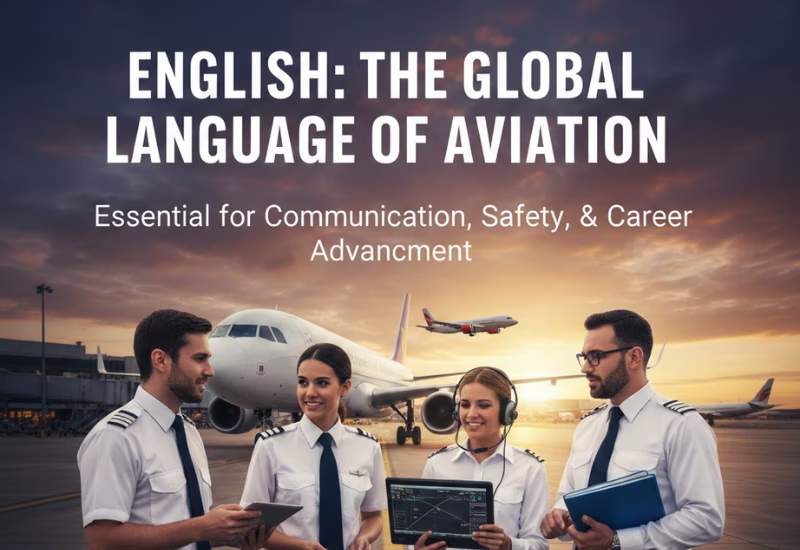
""I have all the qualifications, but my English is weak. Can I still become cabin crew?" This question comes from almost every second student in Vadodara. The honest answer? Weak English is the single biggest barrier to aviation careers. Aviation English is not optional—it is mandatory. English is the official language of international aviation, required by ICAO (International Civil Aviation Organization). Without proper English speaking course training, even the most qualified candidates fail interviews and lose career opportunities. But here is the good news: English skills can be developed. With focused training, students from Gujarati-medium backgrounds have become successful cabin crew and ground staff."
Why Aviation English is the Universal Language of Flying
Before discussing skills development, understand why aviation English is non-negotiable:
ICAO Language Requirement:
The International Civil Aviation Organization (ICAO) mandates English as the language of international aviation. This means:
✈️ All pilots and air traffic controllers must be English proficient ✈️ All international flight communications are in English ✈️ Safety announcements must be in English (plus local language) ✈️ Documentation and manuals are in English ✈️ Cabin crew must communicate with international passengers in English
Why English Specifically:
🌍 Safety Standardisation: One language prevents miscommunication in emergencies 🌍 International Operations: Crew from different countries must communicate 🌍 Passenger Service: International passengers expect English service 🌍 Career Mobility: English opens doors to global airlines
The India Reality:
Indian airlines operate international routes to 50+ countries. Even domestic airlines like IndiGo and Air India fly internationally. English proficiency is essential for all crew members.
Our Air Hostess Training programme includes comprehensive English speaking course modules.
Aviation English vs General English: Key Differences
Aviation English is specialised—different from general English or school English:
General English: - Everyday vocabulary - Casual grammar acceptable - Regional accents tolerated - Informal communication style
Aviation English: - Industry-specific terminology - Precise, clear grammar - Neutral accent preferred - Formal, professional communication
Key Components of Aviation English:
1. Aviation Terminology: - Aircraft parts (fuselage, galley, lavatory, overhead bin) - Procedures (pre-flight briefing, cross-check, arm/disarm) - Emergencies (evacuation, brace position, flotation device) - Service vocabulary (beverage service, special meals, upgrade)
2. Phonetic Alphabet: - Alpha, Bravo, Charlie... (NATO phonetic alphabet) - Used for spelling passenger names, flight numbers - Essential for radio communication
3. Standard Phraseology: - "Ladies and gentlemen, we are now beginning our descent..." - "Please return to your seats and fasten your seatbelts..." - "We apologise for any inconvenience caused..."
4. Safety Language: - Emergency announcement scripts - Evacuation commands - First aid communication
5. Service Communication: - Polite requests and responses - Handling complaints diplomatically - Upselling and recommendations
| Level | Name | Description | Aviation Suitability |
|---|---|---|---|
| Level 1-3 | Pre-Elementary to Pre-Operational | Basic to intermediate English, frequent errors | Not suitable for aviation |
| Level 4 | Operational | Sufficient for routine situations, occasional errors | Minimum for cabin crew |
| Level 5 | Extended | Fluent in complex situations, rare errors | Preferred for international crew |
| Level 6 | Expert | Native or near-native proficiency | Ideal for premium carriers |
“One of the best institute for hospitality. faculties are friendly and also show the right way.”
What Airlines Expect: Most Indian and international airlines require ICAO Level 4 minimum for cabin crew. Premium carriers (Emirates, Qatar, Singapore Airlines) prefer Level 5-6. Ground staff typically need Level 4. The Good News: With proper English speaking course training, students can progress from Level 3 to Level 4-5 within 6-12 months. The key is focused, aviation-specific training—not generic English classes.
How Poor English Speaking Skills Affect Aviation Careers
Weak aviation English has real consequences at every career stage:
Interview Stage:
❌ Immediate Rejection: Poor English = instant elimination ❌ Group Discussion: Cannot contribute effectively ❌ Personal Interview: Struggles to articulate answers ❌ Announcement Test: Fails to deliver clear announcements
Training Stage:
❌ Comprehension Issues: Cannot understand English training materials ❌ Exam Failures: Written tests are in English ❌ Practical Assessments: Cannot perform role-plays adequately ❌ Termination Risk: Some trainees are let go for language issues
Career Stage:
❌ Limited Routes: Assigned only to domestic sectors ❌ Lower Salary: Miss international sector allowances ❌ Slow Promotions: Leadership requires communication skills ❌ Passenger Complaints: Miscommunication leads to negative feedback
| Role | Weak English (Domestic Only) | Strong English (International) | Difference |
|---|---|---|---|
| Cabin Crew (Entry) | ₹30,000-40,000 | ₹50,000-70,000 | +₹20,000-30,000 |
| Cabin Crew (3 yrs) | ₹40,000-50,000 | ₹70,000-1,00,000 | +₹30,000-50,000 |
| Senior Crew (5+ yrs) | ₹50,000-65,000 | ₹1,00,000-1,50,000 | +₹50,000-85,000 |
| Ground Staff (Entry) | ₹18,000-22,000 | ₹25,000-35,000 | +₹7,000-13,000 |
| Customer Service Manager | ₹40,000-55,000 | ₹60,000-90,000 | +₹20,000-35,000 |
The Math is Clear: Over a 10-year aviation career, strong aviation English can mean ₹50-80 lakhs more in earnings compared to weak English speakers. The return on investment for an English speaking course is enormous.
English Speaking Course: What Aviation Aspirants Need
A proper English speaking course for aviation should cover these areas:
1. Pronunciation & Accent Neutralisation:
🗣️ Clear consonant and vowel sounds 🗣️ Reducing mother tongue influence 🗣️ Stress and intonation patterns 🗣️ Pace and clarity of speech
Why It Matters: Passengers and crew from different countries must understand you clearly. Heavy regional accents can cause confusion, especially in emergencies.
2. Vocabulary Building:
📚 General professional vocabulary (500+ words) 📚 Aviation-specific terminology (200+ terms) 📚 Customer service phrases 📚 Emergency procedure language
3. Grammar Fundamentals:
✏️ Correct tense usage ✏️ Subject-verb agreement ✏️ Polite request formations ✏️ Error-free sentence construction
4. Listening Comprehension:
👂 Understanding different English accents 👂 Comprehending fast speech 👂 Following instructions accurately 👂 PA system clarity
5. Speaking Confidence:
💬 Overcoming hesitation 💬 Thinking in English, not translating 💬 Handling unexpected questions 💬 Public speaking for announcements
6. Professional Communication:
🎯 Formal vs informal registers 🎯 Email and written communication 🎯 Handling complaints diplomatically 🎯 Cross-cultural communication
English Skills Assessment in Aviation Interviews
Airlines assess aviation English through multiple methods:
1. Group Discussion (GD):
💬 What They Watch: Vocabulary, grammar, confidence, clarity 💬 Common Topics: Current affairs, teamwork, customer service scenarios 💬 Duration: 15-20 minutes 💬 Tip: Speak clearly, not fast. Quality over quantity.
2. Personal Interview (PI):
💬 What They Watch: Articulation, comprehension, spontaneity 💬 Common Questions: Tell me about yourself, why aviation, situational questions 💬 Duration: 10-15 minutes 💬 Tip: Prepare answers but don't memorise robotically.
3. Announcement Test:
📢 What They Watch: Pronunciation, pace, tone, clarity 📢 Task: Read standard announcements aloud 📢 Challenge: Correct pronunciation of aviation terms 📢 Tip: Practice announcements daily until natural.
4. Versant/English Proficiency Test:
📊 Format: Computer-based assessment 📊 Components: Reading, listening, speaking, comprehension 📊 Scoring: Automated scoring against native speaker benchmarks 📊 Used By: IndiGo, SpiceJet, ground handling companies
5. Role-Play Scenarios:
🎭 Scenario Examples: Handling angry passenger, selling duty-free, emergency situation 🎭 What They Watch: Vocabulary, problem-solving, professionalism 🎭 Tip: Stay calm, use polite language, offer solutions.
The Reality:
Many technically qualified candidates fail at English assessment. Strong skills in communication can compensate for average academics, but the reverse is not true.
Improving Aviation English: Practical Daily Practices
Here are proven methods to improve your aviation English skills:
Daily Speaking Practice (30 mins):
🗣️ Read English newspaper articles aloud 🗣️ Practice aviation announcements in front of mirror 🗣️ Record yourself and identify errors 🗣️ Shadow English news presenters
Listening Practice (30 mins):
👂 Watch English news (BBC, CNN) without subtitles 👂 Listen to aviation YouTube channels 👂 Watch cabin crew vlogs in English 👂 Practice understanding different accents
Vocabulary Building (15 mins):
📖 Learn 5 new words daily 📖 Use flashcard apps (Anki, Quizlet) 📖 Create an aviation terminology notebook 📖 Practice using new words in sentences
Grammar Improvement:
✏️ Use grammar apps (Grammarly, English Grammar) ✏️ Review common errors daily ✏️ Practice tense exercises ✏️ Read grammar explanations
Confidence Building:
💪 Speak English with family (even if uncomfortable) 💪 Join English speaking clubs 💪 Practice with language partners 💪 Embrace mistakes as learning opportunities
Aviation-Specific Practice:
✈️ Memorise standard announcements ✈️ Practice phonetic alphabet daily ✈️ Learn emergency procedure vocabulary ✈️ Role-play passenger interactions
Common English Mistakes by Gujarati Students
Students from Gujarat often make specific aviation English errors. Awareness helps correction:
Pronunciation Issues:
❌ "W" and "V" confusion ("Welcome" instead of "Welcome") ❌ "S" and "SH" confusion ("Sit" vs "Sheet") ❌ Silent letters ignored ("Knight" pronounced with K) ❌ Word stress on wrong syllable
Grammar Errors:
❌ Subject-verb disagreement ("He don't" instead of "He doesn't") ❌ Tense confusion ("Yesterday I go" instead of "Yesterday I went") ❌ Article omission ("Give me pen" instead of "Give me a pen") ❌ Preposition errors ("I am working since 2 years")
Vocabulary Gaps:
❌ Literal translation from Gujarati/Hindi ❌ Using informal words in formal contexts ❌ Limited range of expressions ❌ Repetitive vocabulary usage
Confidence Issues:
❌ Speaking too softly ❌ Long pauses while translating mentally ❌ Hesitation sounds (um, uh, basically) ❌ Avoiding speaking to prevent mistakes
How to Overcome:
These patterns are common and correctable. A structured English speaking course with trained instructors can identify and address these specific issues within 3-6 months.
Aviation English Training at Wings Institute Vadodara
At Wings Institute, aviation English development is integrated into every programme—not an add-on.
Our English Speaking Course Approach:
📚 Daily Speaking Practice: - Every student speaks English in class daily - Group discussions 3 times per week - Individual presentation practice - Recorded sessions with feedback
📚 Aviation-Specific Content: - Standard announcement training - Phonetic alphabet mastery - Emergency communication drills - Customer service dialogues
📚 Pronunciation Correction: - Common error identification - Accent neutralisation exercises - Mirror and recording practice - Native speaker audio exposure
📚 Interview Preparation: - Mock GD sessions - PI practice with feedback - Versant test preparation - Announcement test drills
Why Our Approach Works:
✅ Immersive Environment: English-only policy during training hours ✅ Practical Focus: Real-world scenarios, not just grammar rules ✅ Individual Attention: Small batches allow personalised correction ✅ Continuous Assessment: Regular progress tracking ✅ Industry Alignment: Training matches airline assessment criteria
Success Stories from Gujarat:
💬 "I came from a Gujarati-medium school with very weak English. Wings Institute's daily speaking practice transformed my confidence. I cleared IndiGo interview in first attempt." — Priya S., Cabin Crew
💬 "The announcement practice was game-changing. Other candidates struggled while I delivered perfect announcements. Now I'm with Air India." — Rahul M., Cabin Crew
Our Location:
📍 Address: 2nd floor, RG Square 14, Nutan Bharat Society, Alkapuri, Vadodara - 390007 📞 Phone: +91-8758754444 🕐 Hours: Monday to Saturday, 10:00 AM - 7:00 PM 📍 Directions: Open in Google Maps
Explore our Air Hostess Training, Airport Management, Ground Staff Training, and Hotel Management programmes—all with integrated English development.
Conclusion: English Skills Build Aviation Careers
Let me summarise why aviation English and English speaking course training are essential:
The Non-Negotiable Facts:
✈️ English is mandatory: ICAO requires it for international aviation ✈️ Interviews filter on English: Weak speakers are eliminated early ✈️ Career growth requires English: International routes, promotions, leadership ✈️ Salary depends on English: ₹50-80 lakhs more over a career with strong skills
What You Need to Do:
1️⃣ Assess honestly: Know your current level 2️⃣ Start daily practice: Speaking, listening, vocabulary 3️⃣ Get professional training: Structured English speaking course 4️⃣ Focus on aviation: Learn industry-specific language 5️⃣ Practice announcements: Master the spoken skills
The Encouraging Reality:
English skills can be developed. Students from Gujarati-medium backgrounds, with dedicated practice and proper training, have become successful cabin crew at IndiGo, Air India, Emirates, and more. Your current level is not your limit—your commitment to improvement is.
Ready to start your career?
Visit Wings Institute in Alkapuri, Vadodara for a free counselling session. We will assess your current English level and create a personalised improvement plan aligned with aviation requirements.
📞 Call: +91-8758754444 📍 Address: 2nd floor, RG Square 14, Nutan Bharat Society, Alkapuri, Vadodara - 390007 🕐 Hours: Monday to Saturday, 10:00 AM - 7:00 PM 📍 Directions: Open in Google Maps
Your English improvement journey starts today. Let Wings Institute guide you to fluency.
“Good institute in vadodara for aviation industry”

Rupal Jariwala
Verified Google ReviewFrequently Asked Questions
Why is English important in aviation careers?
What is aviation English and how is it different from general English?
What English level is required for cabin crew jobs?
Can I become cabin crew if my English is weak?
How do airlines test English in interviews?
How can I improve my aviation English quickly?
What are common English mistakes by Gujarati students?
How does English affect aviation salary?
Does Wings Institute provide English speaking course?
How long does it take to become fluent in aviation English?
“Joining Wings Institute was the best decision I ever made! The environment is so positive and encouraging. The faculty gives individual attention to every student and helps polish our personality, grooming, and interview skills. Truly the best aviation and cabin crew institute in Gujarat.”
Improve Your English Skills
Don't just read about it. Experience it. Use our AI tools to assess your current standing for free.
Action Now